
photo_2026-02-09_17-40-51

Start a Trust / Society for School

To start a school in India one has to begin with forming a TRUST/ Society. 

Q.1 Can an individual start a School without forming a Trust/Society?

The existing norms stipulate that educational Institutions must be run as service to the community. Accordingly, the opening of new schools in the private sector and subsequent affiliation with State Education Board / CBSE /CISCE, is permissible only if they are established by a registered Welfare / Charities / Educational Trust or Society. Therefore, any individual / organization / association / society willing to open a new school, requiring recognition of the State Government and affiliation with any State / Central Board will have to constitute a Non-Proprietary Trust / Society, duly registered under Indian Trust Act-1882 or Society Registration Act – 1860. Now CBSE also permits Companies registered under Sec 8 (Section 25 companies are called as Section 8 companies as per the Companies’ Act 2013) to establish schools. Details are available with

Q.2 What is the procedure for constitution & registration of Trust /Society?

Some of the salient points for constitution / registration of the Trust / Society are given below: –

  1. a) Finalize the name of Trust / Society and fix the official location for operation of the Trust / Society.
  2. b) Finalize the name of the chairman & another minimum of two members of the Trust or seven in case of Society. The members of the Trust should not be blood-related to each other to ensure proprietary character of the Trust.
  3. c) Obtain the electricity connection and landline telephone connection and open a bank account in the name of the Trust / Society.
  4. d) Submit the relevant official documents for registration of the Trust / Society to the Assistant / Deputy Charities Commissioner of the area / district, where the office of the Trust / Society is located.
  5. e) If required, seek local assistance from any legal / non-legal person experienced in registration of the Trust / Society.
  6. f) Apply for Income Tax exemptions under various sections, including 80 G and 12 A.

Q.3 How many minimum members are required to form a Trust/Society?

A Trust can be formed and registered with a minimum of 03 members and a maximum of 21 members. In case of Society, minimum of 7 members are required.

Q.4 What is the kind of Trust/Society required for a school project? What are the conditions put by CBSE / ICSE to form a trust?

Any Religious / Welfare / Educational Trust or Society can set-up Institutions for school / professional / medical / engineering education for service to the society, provided this aim has been mentioned in the Trust Deed or Society bye-laws. The Trust should be of a Non- proprietary character so that it does not vest control in a single individual or members of a family.

Q.5 Is it necessary to form a Trust/Society?

Yes, it is absolutely necessary to form a Trust for setting up a School. As per CBSE / CISCE bye-laws, the schools administered and managed by a registered Trust / society are only eligible for affiliation with these Boards. Of late, CBSE also permits Companies registered under Sec 8 (Section 25 companies are called as Section 8 companies as per the Companies’ Act 2013) Details are available with LIFE EDUCARE PVT. LTD..

Q.6 What is the purpose of forming a Trust/Society rather than running a school by an individual?

As per the rules in force, no part of the income accrued from the school shall be diverted to any individual in the Trust. The Trust / Society has to ensure that the saving after meeting all recurring expenditure in the school shall be utilized for providing additional facilities / infrastructure in the school. Thus commercialization of education can be avoided, if the schools are managed / administered by the registered Trust / Society.

Q.7 i) Can the members of the same family become members of the Trust?

  1. ii) Can the Blood Relations form a Trust?

The husband, wife, son, daughter singly or jointly can be the members of the Trust provided that they do not vest control of the Trust. In other words, if the husband as well as the wife (2trustees), are the members of the Trust, then the Trust should have another 3 to 4 trustees who are not members of the same family, to prevent the husband-wife team vesting the control of the trust. Thus the total membership of the Trust in this case will have to be enlarged to 5 or 6 Trustees, out of which 3 to 4 Trustees should not be from the same family. Likewise, in case a trust is constituted with husband, wife and son / daughter (three trustees), then the Trust will have to have another 4 to 5 trustees, who are not the members of the same family.
photo_2026-02-09_17-40-49

Managing a CBSE, ICSE, IB School in India

Q.1 Who will finally control the functioning of the school?

The registered Trust / Society constituted under Indian Trust Act 1882 / Societies Registration Act – 1860 with be responsible for the establishment and administration / management of the school as per the objectives set forth in the Trust Deed / Memorandum of Association and bye-laws of the Trust / Society. The Trust / Society will have absolute powers to frame or amend or modify rules and regulations, objectives, policy directives for administration and management of the school, in accordance with the relevant laws of the Trust / society, the organizational set-up of LIFE EDUCARE MANAGED schools will be as follows:

SCHOOL MANAGEMENT_OPTION PARTNERS

Q.2 Will your have experts and celebrities in the field of Sports, Music and Creativity in the Management committee?

As per affiliation bye-laws of CBSE, all schools have to constitute a School Management Committee (SMC) comprising a minimum of 11 members and maximum of 21 members. In the School SMC will, inter alia, comprise 02 Educationists, 01 female educator, 2 parents, two teachers and also eminent personality in the field of art / culture and 01 professional administrator / CA / Doctor / Architect. The chairman of SMC should make all our efforts to approach the eminent personalities in their respective field and have them included in the SMC with their prior and written consent. In addition, any other celebrity in the field of games / sports may also included in the SMC.

Q.3 What will be the various committees which will help the functioning of the school?

  1. As per the organizational set-up, all LIFE EDUCARE MANAGED Schools will function under the overall administrative control of the Trust. The day-to-day functioning of the school will be entrusted to the School Management Committee (SMC) by the Trust. The SMC will manage the school as per the objectives and vision of the Trust and will be assisted by four sub- committees to ensure the efficient functioning of the school. The four sub-committees of the SMC are:I) Finance / Executive CommitteeII) Staff Selection CommitteeIII) Sports / Extra-Curricular Activities CommitteeIV) Co-curricular / Cultural Affairs CommitteeV) Other Academic committees formed by the principal such as examination, events, quiz, science, discipline etc.
  2. All complaints or matters pertaining to the functioning of the school will be brought to the notice of the Principal (Administrative Head) of the school or any of the sub – committees or School Management Committee.

photo_2026-02-09_17-40-47

What is the TIME FRAME for starting a school in India

This post is meant as an idea guide for clients willing to sign with Life Educare

Q.1 If I am signing an agreement today, when can the school be operational?

The most crucial actions required to be undertaken for starting a school are:

  1. a) Formation & Registration of a Trust / Society
  2. b) Acquisition of Land
  3. c) Construction of the School Building

Therefore, time required to make any school to be consulted by Life Educare will entirely depend on the speed with which above jobs are executed by the Trust. If all the actions mentioned above are well coordinated, it should be possible to make a school operational in about 12 Months.

Timelines for School in India Option Partners


Q.2 What will be the time frame to start the school, after signing the agreement?

The Time Frame for completion of three crucial actions essential for starting a school will primarily depend upon the initiative, action orientation and level of involvement of the Trust. However, average time frame for completion of these activities are as given Life Educare managed schools:

Ideally a time period of 45-50 weeks is required to start a school from thought to finish.

Q.3 What are the different pre-requisites required for taking-up the project for the school?

Any individual or a group of individuals willing to start School should undertake the following procedures / formalities:

  1. Be in possession or agreeing to acquire minimum 1.5 Acres land in non-metro and 0.75-Acre land in metro locations. Though, the actual land required may be more.
  2. Should have formed or agreeable to form a Trust / Society under Indian Trust Act-1882 / Bombay Public Trust Act-1950 or Societies Registration Act-1860 or a section 8 company.. The trust should be of non-proprietary character.
  3. Should have proof of adequate financial resources to guarantee commencement of the school project within a reasonable time frame.
  4. Should have passion for service to the society.

Q.4 How can a Trust minimize the time for starting of the school project?

Considering that a normal time frame for starting a full-fledged school is 12 months. The New academic session for all CBSE affiliated schools commences on 01 April every year. Accordingly the project has to be started. In case of delay in commencement, Life Educare Team can help speed up the process by using its Partner Network. For example, the architects we work with can help design the campus with reduced time frame and yet deliver quality.

Q.5 Can a Trust / Society already formed / registered start the school in a temporary hired building?

Legally it’s possible, however the lease should be for minimum 33 years, else CBSE permission will not be granted, however Life Educare does not work on such projects.

photo_2026-02-09_17-40-45

Growth of a School in India

How does a School Grow?

Q.1 How many sections per class does a Life Educare Managed schools need to have to start with ? How will the school grow thereafter?

Depending upon the infrastructure available at Life Educare managed Schools can be started as 1- Section to 4 – Section school. However, it is recommended to start a new Life Educare School as 2 – Section school from standard I to VI. Keeping In view the financial viability of the project, this school will gradually witness vertical growth up to Senior Secondary level (10+2) during the next 5-year period.

Q.2 Can a Trust start the School up to standard II or III or IV?

Any Trust can start the School up to standard II or III or IV. However, Life Educare recommends that all schools should start classes from standard I to VI with 2 sections in each class. The advantages of this practice will be as follows:

  1. a) The schools can apply for affiliation to CBSE for middle class syllabus as soon as the school starts classes for standard VI in the following year.
  2. b) The school will initially start with about 300 children on its rolls. This will generate necessary revenue income to provide financial stability to the school.

Q.3 The School will be up to which class?

Starting with a 2-section school from standard I to VI, Life Educare MANAGED School will witness horizontal as well as vertical growth with addition of 2 sections in the next higher class in the following years till the schools attains the status of secondary school (upto class X). Further, vertical growth to senior secondary school (upto class XII) will depend upon the provisioning of the requisite infrastructure in these schools.

Q.4 What are the future plans of Life Educare MANAGED Schools for collaboration with foreign institutes?

Life Educare aims to enter into a strategic alliance with world class educational institutes & universities for exposing Indian children to the International arena of school education by introducing renowned curriculum comprising International General Certificate of Secondary Education (IGSCE) by Cambridge University and International Baccalaureate (IB) Diploma, Geneva.

Q.5 What are the stages of development of Life Educare MANAGED? Will it grow into a college?

All Life Educare managed Schools will gradually grow from Primary stage (Class I to VI) to Middle School syllabus (I to VIII) and further to secondary stage (Class I to X). The Life Educare managed Schools will finally become senior secondary Schools (Class I to XII), depending upon the availability of infrastructure in the respective school.

photo_2026-02-09_17-40-44

Financing a School Project

How much money does it take to start a school

Q.1 Will Life Educare have a tie-up with Bank / Financial Institutions for financing the project ?
Yes, LIFE Educare would assist in preparing Bankable project report and obtaining bank finance as it has team of professionally qualified team of Chartered Accountants. The detailed business plan prepared by Life Educare, required to be submitted to the Bank for the financing proposal, would be made available to the Trust after signing up of a separate project finance agreement to facilitate the financing of the project, as mutually agreed. However, finance would be available solely on operational merits of the trust/society.

Q.2 How much investment will be required for Life Educare Project?
The Investment plan will vary according to the model of the school the Trust opts for and the location it chooses. Life Educare would prepare a separate Project Financial Statements and present before the Trust / Society. Such figures are as per standard business plan and may vary 10% – 15% depending upon architectural design & building layout plans quality and quantity of infrastructure.

Q.3 How much income will be generated in the school project?
With key drives and the parameters remaining as planned in the financial projections (which excludes cost of land), the school can be expected to have positive cash flow from the end of the third year. Since the capital outlay is spread over a number of years, available surplus thereafter is projected to meet the part of annual capital expenditure in the future years. The actual results may vary depending upon variation in key business parameters viz. school expansion plans, capacity utilization etc. The individual model-wise financial plans are available with Life Educare

Q.4 What ever income accrues in the school, will it be tax-free?
The income generated by the non-proprietary and Charitable Trusts, managing the school, is tax free up to one crores as per prevailing CBDT directives.

Q.5 What would be the cost of the project if we include the land?
The cost of land would vary substantially with location and size of the plot, which could be added to the cost indicated above.

Q.6 What is the time frame to achieve the break-even point?
Under ideal condition, operational expenses are expected to break even in the middle of the second year. These projections are based on the key parameters; level of activity projected and fee structure. Actual performance and resultant achievement will modify these projections to that extent.

photo_2026-02-09_17-40-53

Deciding the Fee structure for a School

How does one arrive at Fee Structure for an upcoming school

Q.1 How will be the fees be determined?

The issue pertaining to school fees structure will be examined critically and reviewed periodically by Life Educare, based on the ground realities. Based on the market study and competitor analysis along with Differential Analysis, a Performa will be forwarded by Life Educare to the Societies / Trusts on annual basis. The fee will then be finalized by the Chairman. Due considerations will be made for the following in determining the fee structure:

  • Demographics of the city
  • Economic factors
  • Rules / Guidelines of the Central / State Government or its Bodies
  • Guidelines or Norms of Affiliating Body, if any
  • Fees charged by other Schools in the same city
  • Cost of Education per student at Life Educare managed School.
  • Social factors leading to scholarships, freeships, etc.
  • Consideration of students from various backgrounds, including consideration for students with track record / contribution in sports, Arts, Music, Dance,
  • NCC, Scouts, NSS, Other such activities / talents
  • Financial Cost of the Project

Q.2 What will be the fee structure at LIFE EDUCARE MANAGED Schools.?

As per the guidelines issued by the CBSE, the fee charged in any school will have to be commensurate with the facilities provided in the school. Keeping in view the proposed state- of-the-art infrastructure and top-of-the-line technology induction in the School, the following type of fees will be charged in these schools.

Sr. No.     Periodicity of Fee/Payment       Type of Payment / Fee

1           One Time Payment                         Admission Fee &  Security Deposit (Refundable)

2           Monthly / Quarterly Fee               Tuition fee, Annual Charges, Amalgamated Fee, Bus/Conveyance Fee

(These heads of fee are allowed as per the Right to Education Act – 2009.)

Q.3 Who will finalize the fee & fee structure to be charged from the students?

The fee structure at various Life Educare managed Schools will be based on the ground realities at the location of the school and promulgated by the Trust after mutual consultation.

Q.4 What is the rate at which the fee would be increased every year?

The Tuition Fee & other fees including Security will be promulgated by the Societies / Trusts in consultation with Life Educare, at the commencement of the academic session and these fees will not be revised during the middle of the academic session. As per the guidelines issued by the CBSE, the parents’ representatives will be consulted before any upward revision in the fee structure, in the beginning of the academic session. However as per RTE Act-2009, schools are not allowed to increase the fee more than 10%.

Q.5 Will the school provide any fee concessions? What category of children will be granted fee concession in the school ?

The Society / Trust may grant fee concessions to certain category of children studying in the schools. This fee concession may be permissible only in respect of monthly Tuition Fee and all other additional fees viz. Activities Fee, Term Fee, computer / science Fee, Admission, Pupil’s Fund & Security Deposit will be payable in full. Some of the forms of concession that a Society / trust may consider are:

(a) No monthly tuition fee will be payable by the parents having ‘single Girl Child’ in the family.

(b) Maximum of two children (Brother or Sister) of the regular teaching or non- teaching staff of the school.

(c) 20% remission in Tuition fee in respect of second child, in case two children (Brother or sister) of the same parents are studying concurrently in the school.

(d) Full or half tuition fee exemption in respect of poor but deserving & meritorious students or budding / outstanding sports person or talented in the field of art / culture, subject to a maximum of 10% of the total strength of students in each class.

Granting of fee concession will be solely at the discretion of the Chairman of the School.

photo_2026-02-09_17-40-39

What is approval from State Government required to start a school in India

Q.1 Who will grant the permissions in the State Education Department for opening School ?

Since the School Ltd. will have classes from standard I to VI, necessary permission to start the School will have to be obtained from the local District Education Officer (primary wing). However, some States in the Country have classified Standard I to IV as Primary and Classes V as Secondary. As such, two approvals are required from such States, One from Primary Wing and another from Directorate of Secondary Education for starting classes for standard V. The details of States requiring 1 or 2 Approvals / Permissions and authority granting such approval / permission are available with LIFE Educare Pvt. Ltd.

Q2. Will there be requirement for any permission of the State Education Department to open the School?

The subject of education has been included in the concurrent list in the Constitution of India. Therefore, prior approval of the State Government will be required for opening of a new school in private sector, irrespective of the board of Affiliation and medium of instruction.

Q3. Will there be any need to obtain any Clearance / Certificate from the State Government ( Ministry of HRD / Education) for affiliation of the school with CBSE?

‘No Objection Certification’ (NOC) issued by the State Government (Ministry of HRD / Education or Secretary “Education”) of the concerned State Government of the School with CBSE. This is required at the Stage of approval with CBSE in Year 02.

photo_2026-02-09_17-40-41

Facilities for students to be provided in a school

What kind of facilities should the school provide?

The school will have to provide the following facilities to the students for efficient functioning of the school:

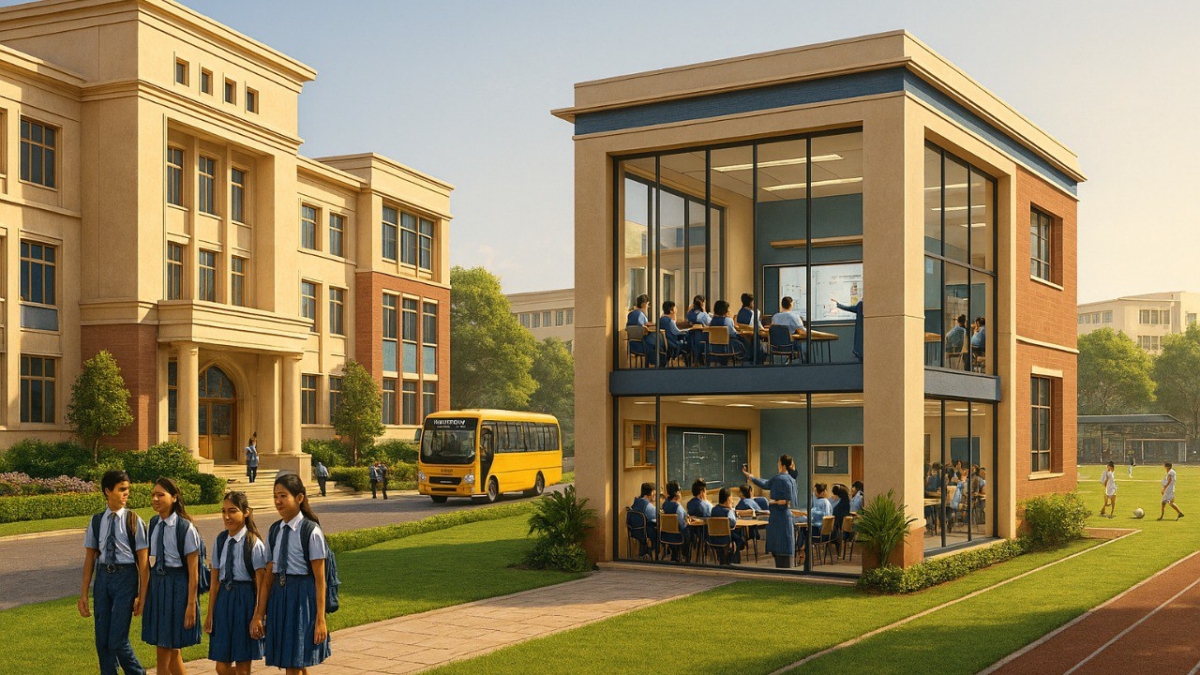
a) Basic infrastructure comprising a highly modern school building designed by a renowned   Architect and spacious Classroom, well-equipped Learning Center, Science & computer   Laboratories, Activities Rooms / Workshops for co-curricular activities and vast play   fields for conducting games and sports.

b) Highly trendy and comfortable furniture in classroom, offices and computer / Science   Laboratories.

c) High – end technology comprising School Management Software for management / administration of school, LCD projectors in class Rooms, Internet with Wi-Fi,   technology, CCTV, smart Cards for students’ attendance system and library transactions.

d) Manpower comprising highly qualified and result oriented teachers for all subjects / disciplines / streams and other administrative / logistics / house keeping / security and support staff.

e) School Bus facility, spacious Canteen and Medical Dispensary.

f) Free insurance cover for all students for Rs. 1Lakh.

g) Medical Dispensary for emergency medical treatment.

Will the School have Dispensary and a doctor?

The School will have a medical dispensary to provide first-aid to the students in case of any medical emergency. The appointment of a full time Nurse will be subject to the strength of students in the School. However, irrespective of the number of students, all schools will have a part time doctor who will conduct medical examination of all students at least twice in an academic year. The results of the medical examination will be recorded in the Student’s Diary.

Will the school have any kind of association with the Hospitals, in case of emergencies?

The school will have a tie-up with the nearest renowned Hospital for attending to the children in case of medical emergency. The school will ensure that any child with a medical emergency is rushed to this hospital using school or hire transport.

Will the students be allowed to avail to the library services after schools and on holidays as well?

The Library services will be available to the students only during the working days. All students will be required to return the library books prior to proceeding for summer vacations. However students can retain the Library Book during autumn and Winter breaks.

Will the school provide any Insurance cover to the students?

All students will be provided free Insurance Cover of Rs. 1 Lakh against any accident during the Bus journey or school working hours.

What support / material will be provided by Life Educare? What kind of help and equipment support can be given by Life Educare to the Trusts?

Under The Scope of Services under the Agreement signed between Life Educare and the Society / Trust details the support and material will be provided.

photo_2026-02-09_17-40-33

Designing Co curricular activities for Schools

Q1. What kind of co-curricular activities will be there in the School?

The School will aim to provide an environment in the school that encourages the development of “Multiple Intelligences” & inner talents of the children, facilitating them to express through music, creative and performing arts. The schools will also aim to provide wide open spaces and play grounds to encourage and conduct variety of games, sports, gymnastics and calisthenics to inculcate qualities of team spirit, leadership and development of skills in organizing ability, interpersonal relations, planning & problem solving.

Q2.

i) What types of extra-curricular activities are planned?

ii) Will the school be taking students on educational trips? If yes from which standard onwards?

Life Educare managed Schools will also lay special emphasis on extra-curricular activities to ensure cultural development of the children and bring about a fine synthesis between modern technology and cultural traditions. Accordingly, as a part of extra-curricular activities, all students from standard I to XII will be taken on organized visits to monuments, museums, sanctuaries, national centers of scientific importance on a regular basis in India and encouraged to participate in adventurous activities organized by the School.

Q3. How often will the students be taken to field trips and to what all places?

To encourage the students for participation in adventure activities, a variety of outward- bound schemes are aimed to be organized, primarily during the autumn break, winter break & summer vacations. The participation in the adventure activities will be permissible to the students mainly from 6th standard onwards.

photo_2026-02-09_17-40-31

Set Curriculum / Syllabus for School

Q.1 What are the important features of curriculum in all ‘Life Educare Managed Schools’?

Keeping in view the spirit of the National Curriculum Framework 2005 Life Educare managed School shall adopt activity-based, child-centered and joyful teaching-learning programme. At the upper primary level, the activities will be more broad-based and suited to children of the higher age group, namely teacher demonstrations, practical work; surveys; nature trails, seminars and computer-aided teaching-learning programs. Every teacher in the school will prepare a well thought-out action plan in the Teacher’s diary, before taking up the teaching-learning program in the class. To assist the teacher in preparing the action plan, a Teacher’s Manual containing unit plans and work sheets have been developed by Life Educare These manuals contain guidelines for teaching lesson in all subjects from standard I to X, based on the new NCERT curriculum based on the National Curriculum Framework for schools (NCFS – 2005), promulgated by Ministry of HRD, Government of India. The work sheets appended to each unit / lesson will evaluate students’ comprehension of the subject matter. Over-emphasis on rote learning, cramming and text-book centered teaching, followed by pen and paper sit-down tests will be avoided, as this approach leaves hardly any scope for the spontaneous development of the children, cultivation of appropriate skills and attitudes among the children will be planned.

Text books and work books prescribed by the NCERT in the subjects of Hindi, English, Mathematics, Environmental Studies / Science & Social Science will be followed in CBSE affiliated School in all the classes.

The Special Educators will also be appointed for identification and counseling of children with learning disabilities / dyslexia.

Q.2 What about the syllabus, are we going along with CBSE / ICSE, and modifying it as per our guidelines ?

  1. All schools affiliated to CBSE are required to follow the curriculum given in the books published by NCERT. The ‘ Teacher’ Manual’ and ‘Work Sheets’ must also be based on NCERT books to facilitate effective teaching – learning process in the schools. The scope lies in pedagogy.

Q.3

i) What streams will the school have for plus 2 students, in terms of science, commerce, and humanities ?

ii) Which all streams of education will the schools be offering to the plus two students?

Presently, it is planned that all schools will conduct classes up to Sr. Secondary (Class XII) level. The introduction of various streams/combinations in Humanities, Commerce & Science at the Sr Secondary stage (10+2), will be undertaken subject to availability of sufficient number of students and infrastructure in the school. In case of sufficiency of infrastructure, the school will enroll students for science stream and one or two other streams subject to availability of at least 15 children in these streams.

Q.4 Will the school have laboratories for humanities as well as psychology etc?

The school are aimed to be set-up Six Laboratories for a (10+2) schools, comprising three science laboratories (Physics, Chemistry & Biology), Computer Laboratory, Language Laboratory and Mathematics Laboratory. The school may also add any additional laboratory pertaining to Social Science & Environment Science subjects at a later stage, and depending on specific academic modeling undertaken by the Life Educare’s Academic Team

Q.5 How will the Curriculum of Life Educare managed Schools be structured ?

All Life Educare managed schools are aimed to follow the curriculum promulgated by NCERT. This scheme envisages general education for 10 years followed by diversified education at the +2 stage. At the end of Class X, the students will appear at the All India Secondary School Examination conducted by the CBSE. The concept of child-centered and activity-based education, and modern teaching-learning methodologies will be emphasized at all stages in the School.

Q.6 Will regional language be an additional subject in schools?

As per the NCERT curriculum, English & Hindi will be the compulsory languages to be taught in Life Educare from standard I to X. The third language will be decided as per the region in which the School is located.

Q.7 Will the students have an access to the Internet? If yes, what would be the criteria for the same?

The School is aimed to have state-of-the-art computer laboratory to provide quality computer education. The computer laboratory will aim to provide unlimited internet accessibility to all students from standard I to XII. A few Schools will also have Wi-Fi connectivity enabling the students to avail of wireless Internet connectivity from any location within the campus.

Q.8 What special steps will be taken for education of Children with Learning Disabilities?

A disorder affecting a student’s ability to interpret what he / she sees or hears or link information from different parts of the brain is considered a Learning Disability (LD). The most common treatment for LD is the special education. The School will initiate following steps for these students.

a) Specially Trained educator to assess child’s academic & intellectual potential.

b) Reinforce virtually what is written on black board or projected on screen.

c) Acquire special LD software particularly in Language Laboratories.

d) Allow upto 50% additional time to write tests.

e) Conduct the Test / Examination in a separate quiet room.

f) Allow the question paper to be read to students with LD.

g) Vary examination format to accommodate student’s individual learning style.