
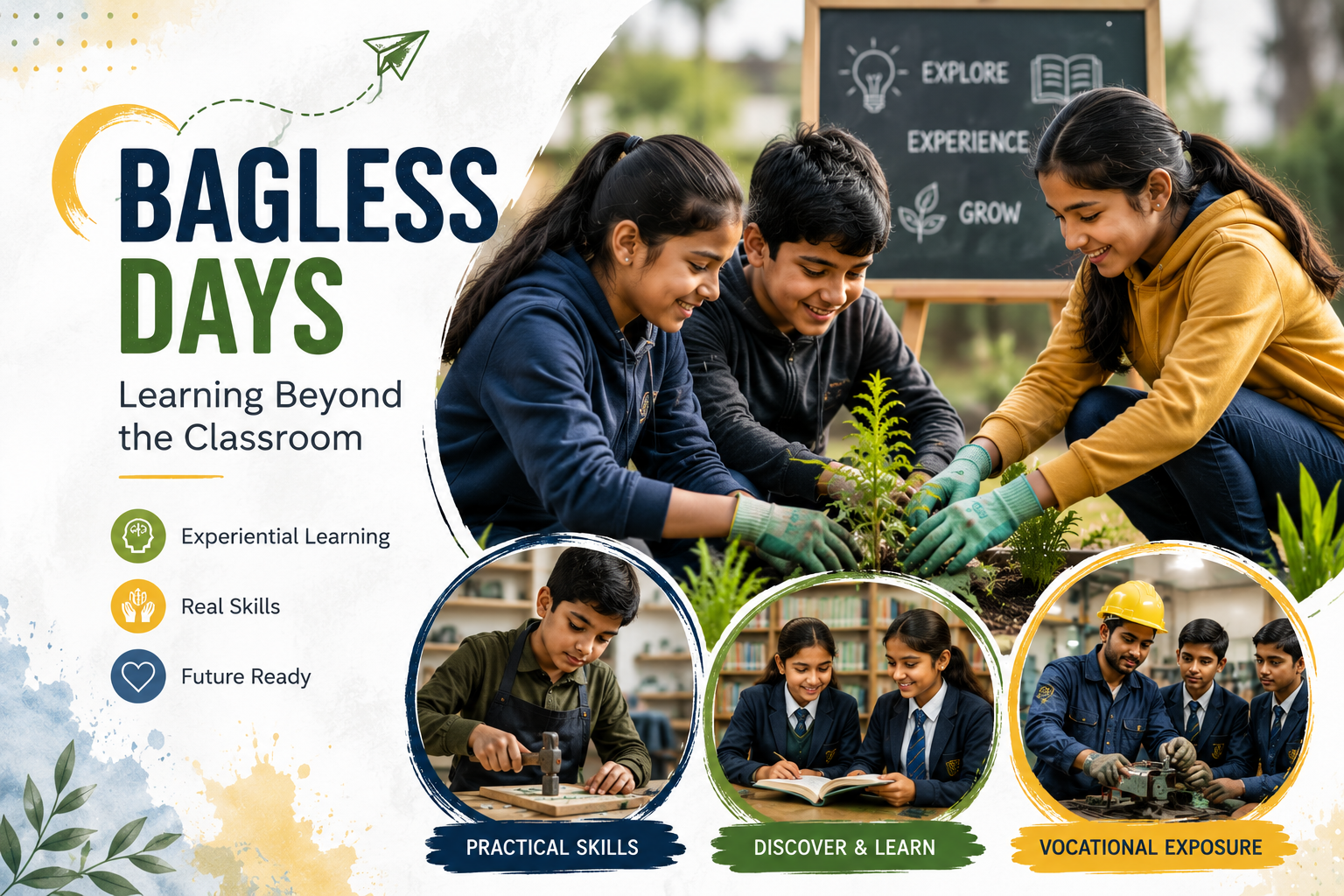
Education is rapidly evolving beyond textbooks, examinations, and rote memorisation. Today, schools are expected to develop practical skills, critical thinking, creativity, and real-world understanding among students. One of the most impactful initiatives introduced under the National Education Policy (NEP) 2020 to achieve this goal is Bagless Days in Schools.
The Bagless Days initiative encourages students to leave their school bags behind and participate in hands-on, experiential learning activities that connect classroom concepts with real-life experiences. Designed primarily for students in Grades 6–8, the programme promotes skill development, vocational exposure, creativity, and holistic learning.
By shifting the focus from memorisation to meaningful engagement, Bagless Days in Schools are helping create confident, curious, and future-ready learners.
What Are Bagless Days in Schools?
The 10 Bagless Days initiative was introduced under NEP 2020 to provide students with dedicated opportunities for experiential learning.
Instead of attending regular classroom sessions, students participate in practical activities, field visits, workshops, surveys, vocational experiences, and community-based projects that encourage active learning.
The initiative aims to:
- Promote experiential learning
- Develop practical and vocational skills
- Foster creativity and innovation
- Encourage critical thinking and problem-solving
- Build stronger connections between education and real life
Rather than learning solely through textbooks, students gain knowledge through observation, participation, and hands-on experiences.
Key Highlights of the Bagless Days Initiative
10 Days Minimum Every Academic Year
As per CBSE and NEP 2020 guidelines:
- Schools must conduct a minimum of 10 Bagless Days every year.
- These days should account for approximately 60 hours of experiential learning activities.
- The programme is primarily designed for students in Grades VI–VIII.
Flexible Implementation
Schools are not required to conduct all 10 days consecutively.
The Bagless Days programme can be:
- Conducted in multiple phases
- Distributed throughout the academic year
- Integrated with school events, projects, and vocational learning activities
This flexibility allows schools to plan meaningful experiences without disrupting academic schedules.
The Triple-H Framework: Head, Hand & Heart
A key principle behind Bagless Days in Schools is the development of the whole child through the Head, Hand, and Heart Framework.
Head
Students develop:
- Critical thinking
- Curiosity
- Observation skills
- Conceptual understanding
Hand
Students engage in:
- Practical activities
- Tool handling
- Experiments
- Creative project work
Heart
Students cultivate:
- Empathy
- Respect for labour
- Teamwork
- Social responsibility
- Love for learning
This balanced approach ensures learning is intellectual, practical, and emotional.
How Bagless Days Support Vocational Education Under NEP 2020
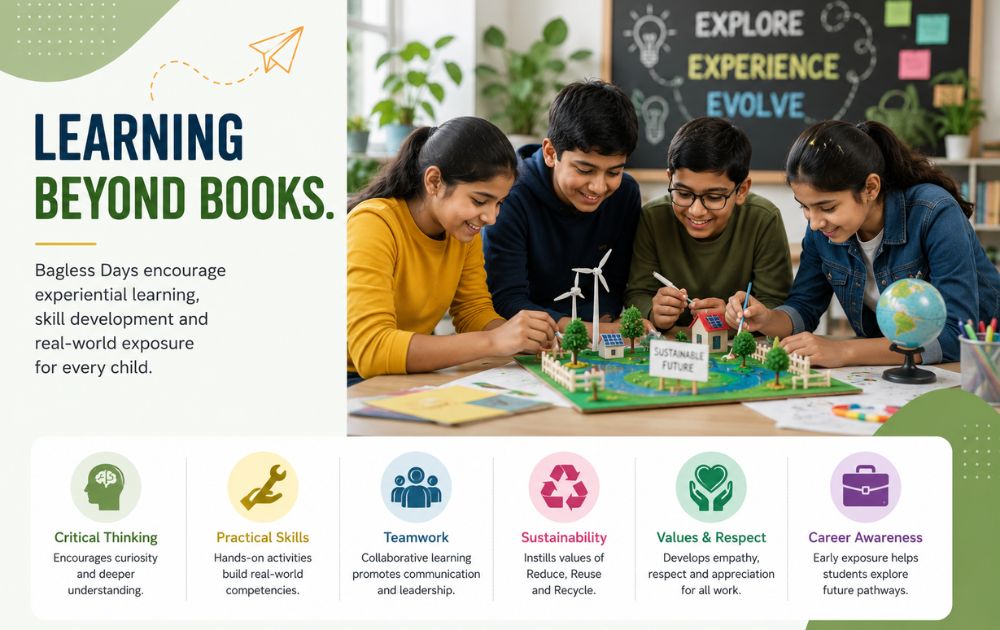
One of the strongest aspects of Bagless Days in Schools is their connection with Vocational Education and the Kaushal Bodh Programme.
These learning experiences allow students to move beyond theoretical understanding and develop practical skills through real-world exposure.
Local Expert Internships
Students can interact and learn from:
- Carpenters
- Potters
- Farmers
- Gardeners
- Local artisans
- Skilled professionals
This helps students understand the value of different professions while learning practical skills.
Institutional Visits
Schools are encouraged to organize visits to:
- ITIs
- Polytechnics
- Skill Development Centres
- Higher Education Institutions
Such visits expose students to future academic and career pathways.
Career Awareness
Early vocational exposure helps students:
- Explore different career options
- Understand workplace environments
- Develop practical competencies
- Make informed future decisions
Schools looking to strengthen vocational learning can also explore our guide on Vocational Education for Middle & Secondary Students.
Curriculum Integration: Every Teacher Has a Role
Bagless Days are not limited to activity periods. The initiative encourages all teachers to connect experiential learning with classroom teaching.
Mathematics
Students can learn through:
- Field measurements
- Data collection
- Surveys
- Practical calculations
Science
Activities may include:
- Nature walks
- Experiments
- Environmental observations
- Community science projects
Languages
Students can engage in:
- Interviews
- Storytelling
- Local history documentation
- Reflective writing
Social Science
Students can explore:
- Community studies
- Local culture
- Heritage projects
- Civic engagement activities
This interdisciplinary approach makes learning more meaningful and relevant.
Core Values Promoted Through Bagless Days
Beyond academic learning, Bagless Days help schools nurture important life values.
Respect for Labour
Students learn to appreciate all forms of work and understand the dignity of labour.
Reduce, Reuse & Recycle
Activities related to sustainability encourage environmental responsibility and awareness.
Lok Vidya and Local Culture
Students gain exposure to:
- Indigenous knowledge systems
- Traditional arts and crafts
- Local languages
- Community wisdom
Inclusivity
Schools are encouraged to ensure meaningful participation of:
- Children with Special Needs (CwSN)
- Students from diverse backgrounds
- Different learning styles and abilities
Creativity & Teamwork
Collaborative projects promote communication, leadership, and innovation.
Assessment During Bagless Days in Schools
One of the most refreshing aspects of the programme is its approach to evaluation.
No Marks, No Grades
Bagless Days focus on:
- Learning experiences
- Participation
- Reflection
- Personal growth
instead of traditional examinations.
Feedback-Based Assessment
Teachers provide:
- Constructive feedback
- Observations
- Guidance for improvement
Peer discussions and self-reflection are also encouraged.
Continuous Improvement
School leaders are expected to:
- Collect stakeholder feedback
- Review programme effectiveness
- Improve future implementation strategies
Parents are also encouraged to understand the educational value of experiential learning and support their children throughout the process.
Why Bagless Days Matter for Future-Ready Education
The future demands more than academic knowledge. Students need practical skills, adaptability, creativity, collaboration, and problem-solving abilities.
Bagless Days in Schools help bridge the gap between classroom learning and real-world application by:
- Encouraging experiential learning
- Strengthening vocational education
- Building confidence and independence
- Promoting creativity and innovation
- Enhancing career awareness
- Developing essential life skills
These experiences prepare students not only for examinations but also for life.
Final Thoughts
The purpose of Bagless Days in Schools is not simply to complete a CBSE requirement or fill spaces on an academic calendar. The true objective is to transform learning into a meaningful, engaging, and practical experience.
When implemented effectively, Bagless Days help students develop skills, values, confidence, and curiosity that textbooks alone cannot provide.
Aligned with NEP 2020, this initiative represents a major step toward creating future-ready learners who can think critically, work collaboratively, and contribute positively to society.
At Life Educare, we help schools successfully implement Bagless Days, Vocational Education Programs, Composite Skill Labs, and NEP 2020-aligned learning frameworks that prepare students for the future.