Q.1 Who will supply the Text Books, Uniform, School Badge, Students Diary & Class Room Furniture?
All Life Educare managed Schools will normally commence operations on 01 April every year. Since most of these schools will be affiliated to CBSE, the entire curriculum will be based on the textbooks published by NCERT. While the schools will arrange procurement and distribution of NCERT Text books locally, the uniforms for children, school calendar and class room furniture will be made available by Life Educare through the Society / Trust to all School’ by March every year, well before the commencement of the new academic session.
Q.2 What infrastructure / facilities are to be provided by Trust prior to commencement of classes in the new school?
The Trusts are to ensure the provisioning of the following facilities by March, before commencement of Classes from 01 April:-
a) Class rooms, Laboratories, Rooms for conduct of co-curricular activities.
b) Furniture for classrooms, offices, laboratories.
c) Equipment for co-curricular activities, classrooms (Teaching-Aids), laboratories including consumables items.
d) Qualified Teaching & Non-Teacher Staff.
e) Drinking water facilities and hygienic standards as per Municipal prescriptions.
Life Educare’s team of experts will assist the Society / Trust in all above tasks, as defined in the Agreement.
Q.3 Will the cost of school uniform and other articles be at market price?
As regards the uniforms and other articles, Schools are required to maintain a high quality and standard for all such items. Therefore, these items will be procured and supplied to the students by Life Educare. The cost of these items will commensurate with the quality of the product.
Q.4 Can the cost of school furniture and other items be controlled, if these are procured locally?
The Life Educare aims to provide state-of-the-art infrastructure in the schools. Therefore, all the items introduced in the school are required to have a stamp of quality. In the initial years, all the classroom furniture, school uniforms, school diaries etc. will have to be procured and supplied by good trusted and leading Vendors to ensure quality and equitable standard. However, the Society / Trust is at liberty to decide otherwise, in consultation with the Life Educare’s Executive Team.
Q.5 What all equipment are to be purchased by the Society / Trust?
All Life Educare managed Schools are aimed to provides state-of-the-art infrastructure in the schools, to maintain high quality and a uniform standard of equipment in the schools. Therefore, Life Educare aims to procure the following items from reputed and nationally accepted vendors short-listed:
i) School furniture
ii) Student’s Academic Items
iii) School uniform / School bag.
iv) School Stationery
v) Lab equipments, instruments and consumables
vi) Instruments & Materials related to Student Activities like arts, music, etc.
vii) Sports equipments and items
viii) ICT Hardware and Software
ix) School Management Software (ERP)
x) Audio-Visual Aids
xi) Teaching Aids & Tools
xii) Interior Decoration Items
xiii) School Facility & Admin Stock Items
A complete and exhaustive list is provided under the document “Resource Planning” prepared by Life Educare.
Q.6 How will Life Educare will ensure uniformity of equipment and interiors in the school?
With a view to ensuring uniformity of interiors and equipment / furniture in all schools, Life Educare will make the following information available to all Schools.
(a) Soft / hard copies of full interiors of Front office, Principal’s office, Class Rooms, Staff Room, Library, PTA conference/visitors’ Room, Science / Computer Laboratories, Dining Hall / Canteen and Staff / Teachers’ Resource Room & other area of the school.
(b) Soft /Hard copies and Drawings of furniture at Front Office, Principal’s Office, Staff Room, Library, PTA Conference Room, Science / Computer Laborites, Canteen/Dining Hall, and Staff/Teachers’ Resource Room etc.
(c) Introduction of School Management Software and smart cards for the children in phased manner.
(d) Details of training equipment comprising LCD / DLP projectors, Branded PCs for Laboratories / Offices, Laptops for Teachers, CCTV, Wi-Fi equipment for Internet connectivity, large screen LCD / Plasma TVs etc.
Q.1 What will be the hygiene level of the water and sanitation in the school?
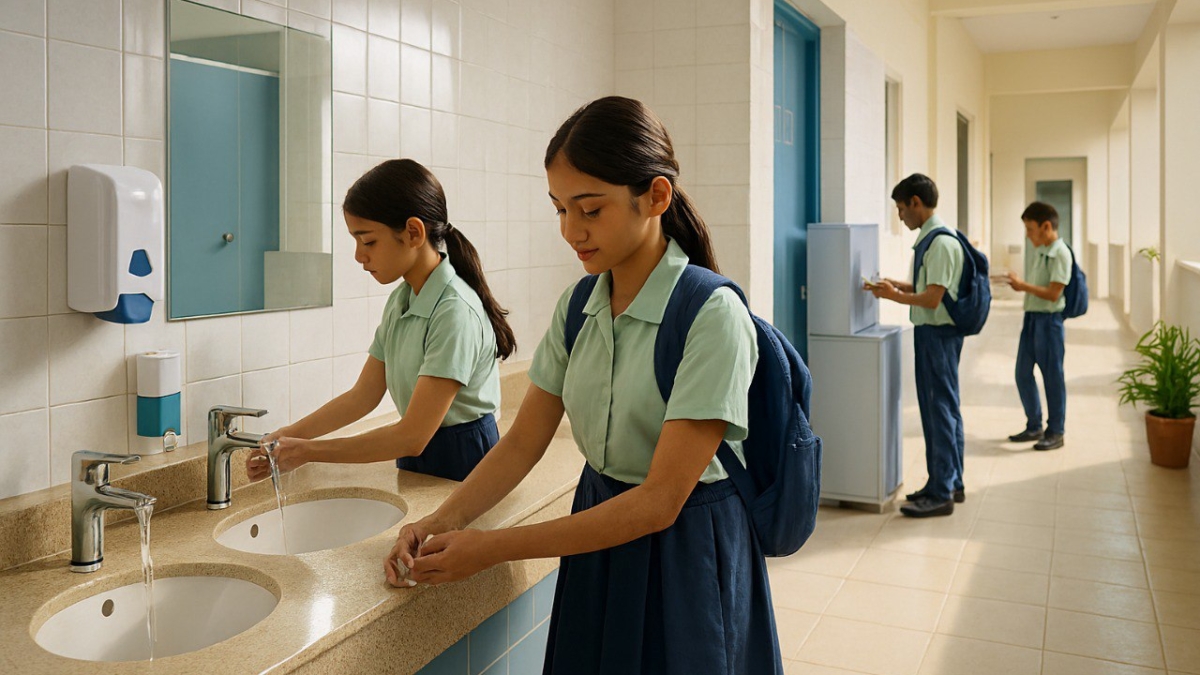
The School will have child-friendly approach to hygiene, sanitation, and water supply facilities, aiming to design facilities that are part of the learning environment and stimulate, & promote appropriate hygiene practices among children. The toilets for children will have dimensions different from those for adults. The schools will also ensure adequate water and storage to meet the requirement of drinking, hand washing and cleaning of toilets. It is envisaged to supply a minimum of 20- 25 liters of water per student per day in the schools. Drinking water storage tanks will be regularly cleaned and if possible checked to ensure that the water is safe for drinking. In addition, all drinking water in the schools will be available for use only after proper treatment through UV / RO water purifiers.
Q.2 What about lunch for children? Are children expected to carry lunch from home or would there be a cafeteria or a mess for them?
The dining Hall in the School will serve preferably vegetarian snacks & lunch to the students, outsourced from a reputed catering agency. The Students will be served fruits, milk, lunch and evening snack. They may also be served with some nutritious snacks during play-hours or on the way back home. A detailed plan and diet chart will be prepared by a Dietician. It is also necessary to bring in variety and change on a regular basis so that the students don’t get bored with food easily.
i) Will the school have a permanent or a visiting counselor in the Schools as it is becoming the need of the hour?
ii) Does staff also include Special Educators / Educational Psychologists /Counselors?
The appointment of school counselors is not a pre-requisite for affiliation of the school with CBSE. Therefore, decision to appoint a counselor will depend upon priority and concern of the school management for the betterment of mental health, discipline and orderly behavior of the students. However, all Life Educare managed Schools aim to appoint a part time school counselor in primary schools followed by a full-time counselor during Middle / Secondary / Senior Secondary level.
Q.2 Will there be requirement of a counselor in the school?
The School Counselors are professional educators with a perspective on the mental health of the children. The appointment of a school counselor certainly helps to save the schooling system from cases of undesirable activities or emotional breakdown or selection of a mis- matched professional career by the youngsters.
Q.3 What are the essential qualifications of the school counselor?
A qualified counselor should have minimum post-graduate qualification in psychology or a graduate with a diploma in counseling.
Ideally all Life Educare managed Schools aim to have 30 children in each class. As regards the teachers, they will be 1.5 teachers for each class in the School. Thus the student – teacher ratio in the school will be 20:1 or lower.
Q.2 Can the school have visiting faculty apart for the fixed ones? If yes, what will be the criteria for appointing them?
As per the CBSE Bye-laws, a school is required to appoint fully qualified teaching faculty on a regular basis. The teachers can be appointed on a contractual basis provided the school is unable to get a subject teacher on a permanent basis. Visiting faculty for academic subject will not be permitted in the school. However faculties for extra school activities and seminars and conferences will be called on a regular basis.
Q.3 What will be process of recruitment of the Principal?
The principals in Life Educare managed Schools are to have high qualities of personal leadership and innovative management skills to lead the high – tech world – class schools in the future years. Depending upon the requirement, the ‘School’ will be issuing advertisements in leading newspapers for the selection of the principals at various locations. Leading web recruiting portals will also be used to source in potential candidates. The Principals of all Life Educare managed Schools will be appointed on transfer basis and as per their strengths they will be transferred.
Q.4 What support will Life Educare provide in recruiting the teachers?
The School Management Committees will have to issue advertisements in the location newspapers for selection / appointment of teachers in the respective schools. The format for the advertisement is given in the Operation Manual. Leading web recruiting portals will also be used to source in potential candidates. In addition, Life Educare also has a vast data bank of the prospective teachers, which will be forwarded to all the Schools to have a wide choice for selection of the teachers.
Q.5
i) Will Life Educare managed help in recruiting the Administration staff?
ii) Will Life Educare managed have a role in appointing the Non-teaching staff or the school authority will decide on the same?
The details of non-teaching staff required to be positioned in s School are given in the Operations Manual. The respective School Management Committee should advertise the vacancies for the non-teaching staff in the local newspapers. The selection of non-teaching staff will be the prerogative of the School Management Committee and Life Educare managed will be providing all support for recruitment of non-teaching staff required by the schools, as per the Agreement.
Q.6 Can schools outsource the services of the Non-teaching staff?
As a matter of policy, all Schools should focus on their core-competencies for delivering quality education & outsource the non-critical school activities. The services for following areas / departments are recommended to be outsourced rather than staff on permanent basis:
a) Security Personnel
b) House Keeping Services / Conservancy Staff
c) Arboricultural (maintenance of lawns / gardens) Services
Q.7
i) What can be the minimum qualification of the staff?
ii) What is the minimum qualification of teachers for recruitment?
All the Teaching staff should have necessary educational and professional qualifications as prescribed by CBSE. The details are as follows
PRINCIPAL – Master Degree (Or Equivalent) with B.Ed. or its equivalent and 5 years of teaching experience in Secondary / Sr. Secondary Classes
TEACHER – (Trained Post Graduate / Graduate in English / Physics / Graduate Teacher) Chemistry / Mathematics / Botany & Zoology / Social Science with B.Ed..
JUNIOR TEACHER (Primary Teacher) – Graduate in English /Hindi/ Mathematics / Physics /Chemistry /Botany & Zoology /social Science with B.Ed.
PHYSICAL EDUCATION TEACHER – Graduate in Physical Education or B.P. Ed.
MUSIC TEACHER – Graduate in/ with Music from recognized university or Secondary with Sangeet Visharad / Sangeet Vidya /Sangeet Prabhakar / Sangeet Visharad / Sangeet Ratna.
SENIOR COMPUTER TEACHER – B.Tech (Computer Science) or MCA or BCA or Graduate/ with 2 – year diploma in computer science.
ART & CRAFT TEACHER – Graduate with drawing & Painting / Art / Fine Arts with 2-years full time diploma or MA in Drawing & Painting / Diploma in Painting / Fine arts.
Q.8
i) To start with how many teachers do we need to appoint in a school up to 6th standard?
ii) What is the minimum number of teachers that one needs to start the school?
Initially School will function as 2 – Section Primary School conducting classes from standard I to VI. The requirement of teachers for running a 2 –Section School with classes from Standard I to VI is given in the following table:
TEACHING STAFF REQUIRED (I to VI, 360 students)
Post under Teaching staff Category No. of Teaching staff *
Principal 1
Vice – principal 1
Senior Teacher Nil
Teacher (Graduate Trained Teacher) 2
Junior Teacher (Primary Teacher) 8
Computer Teacher 1
Physical Education Teacher 1
Art & Craft / Drawing Teacher 1
Music 1
TOTAL 16
*Subject to change, general estimates only.
NON-TEACHING STAFF REQUIRED FOR Life Educare managed School (PRIMARY SECTION)
Post under Non-Teaching staff category No. of Non- Teaching staff*
Senior Administration Executive 1
Junior Accountant 1
Office Assistant / Data Entry Operator 3
Receptionist 1
Security Guard 6
Peon / Plumber/ electrician 5
Others 2
TOTAL 18
*Subject to change, general estimates only.
WORKING HOURS / TIME TABLE
Q.1 What will be the total number of working days in the school during an academic session?
As per the CBSE / ICSE norms, the academic year in School will be from 01 April to 31 March of the following year. The total number of working days in the School shall not be less than 220 days in any academic session.
Q.2 What will be the number of periods / instructional hours per day in the school?
The school will have 42 periods per week for Primary classes, 48 periods per week for Secondary and 54 periods per week for Sr Secondary classes. Based on these norms, the school will have 5 academic hours for Primary, 51/2 academic hours for Secondary and 6 hours for Sr Secondary classes.
Q.3 Will the school follow the 5-day or the 6-day routine?
The School will function for a minimum of 220 days in an academic session and will be open from Monday to Saturday (6-day week) except 2nd & 4th Saturdays, which will be observed as holidays for students. However, teaching and non-teaching staff will observe 4th Saturday as a normal working day to facilitate/ review of lesson plans and unit plans.
Q.4 What will be the school timings?
The school will have 42 periods per week with 5 hours of academic activity for Primary Classes (class I to V) and 48 periods per week with 51/2 hours of academic activity for Secondary (classes VI to X) classes. The school timings for Life Educare managedSchools will be fixed by the School Management Committee keeping in view the sunrise or sunset timings during summer / Winter season. However, the criteria for academic activity hours / Number of period will be strictly adhered to.
Two Central Boards namely CBSE ( Central Board of Secondary Education) and CISCE (Council for Indian school Certificate Examination) formally enroll various schools for following the prescribed/ approved course of studies up to Secondary & Sr Secondary classes for the examinations conducted by the respective Board. Schools can also go for IGCSE or IB boards, if the market research shows the requirement of that kind of school in the area.
Q.2
i) What are the minimum requirements of affiliation with CBSE?
ii) What are the pre-requisites for affiliation to CBSE?
The detailed information pertaining to pre-requisites and procedure for affiliation of the School with CBSE is given in the booklet “CBSE Affiliation Guidelines”, prepared by Life Educare. However, some of the important conditions required to be fulfilled by the schools are as follows:
a) The school should be run / managed by a Trust or society registered under Indian Trust Act 1882 or Societies Registration Act 1860 or relevant Acts of the respective State Governments. The Trust should be of a non-proprietary character. However, the condition for formation / registration of a Trust is not essential incase of schools at foreign locations.
b) The school should have a minimum of 2 Acres of land at non-metro locations and 1 Acre at metro locations. The land should be either registered in the name of the Trust / Society or on a registered lease for a minimum of 33 years at the time of applying for affiliation. It is however suggested that the Society owns at least 1.5 acres of land and may choose to lease the remaining land area.
c) The school should have prior approval/recognition of the State Government. In addition, the school should obtain a No Objection Certificate (NOC) from the State Government to the effect that the State Government has no objection for affiliation of the school with CBSE.
d) The school should have a proper scheme of management with a School Management Committee (SMC) to oversee the day-to-day functioning and management of the school.
e) The school should also have requisite infrastructure comprising classrooms, Laboratories, Activities Rooms, and accommodation for various officers & staff; classroom & office furniture and office & teaching equipment, commensurate with its requirements.
f) The Teaching staff should be paid salaries in accordance with the pay scales prescribed by the Central Government or the State Government.
g) The School should have sufficient financial resources to guarantee its continued existence.
Q.3
i) How will the school be affiliated to CBSE?
ii) What is the date when anyone can apply for the affiliation with CBSE?
The details of the procedure for affiliation with CBSE are given in the booklet “CBSE Affiliation Guidelines, prepared by Life Educare. As the school, will initially conduct Primary Classes upto standard VI, these schools will not be affiliated to any Board. These Schools will however, follow the curriculum of NCERT. As the Schools grow and commence classes in class VII, an Application will be made for affiliation to CBSE for Middle Class Syllabus (Class VI to VIII). The affiliation with CBSE will have to be effected in 3 stages during the period of vertical growth of the school. The prescribed application forms for affiliation are available with the respective Board. However, effective from June 2006, CBSE have also introduced on-line submission of application forms for affiliation. The detailed information pertaining to highest class in the school and the last date for submission of Application for the three stages of affiliation is 30th June every year.
Q.4 At what stage the Schools will apply for Affiliation with CBSE?
School fulfilling the essential norms, will have to apply ‘On-Line’ to CBSE initially for approval of Middle class Syllabus by 30th June of the year, preceding the year in which Class VII is proposed to be started in the school.
Q.5 i) What is the expenditure involved in affiliation?
ii) What are the prescribed fees for affiliation?
The current rates of the affiliation fee payable to CBSE at the time of submitting the application are as given in the succeeding table. However the affiliation fee is subject to change by CBSE:
Type of Affiliation Affiliation fee at the time of Application (Rs)
Approval of Middle Class Syllabus 50,000/-
Provisional Affiliation for Secondary 75,000/-
Up gradation to Sr Secondary 20,000/-
Q.6 i) How much time it takes to get affiliation from CBSE?
ii) Will the schools be evaluated / inspected by CBSE staff ?
Based on the applications received by CBSE up to 30 June, the (CBSE) Board nominates an independent Inspection Team, generally comprising two eminent educationists. The Inspection Team normally visits the School between the months of October to December for carrying out a comprehensive inspection of all departments of the school and based on the report of the Inspection Team, the Schools will be granted conditional or unconditional affiliation by the Board.
Q.7
Can the school be affiliated to State Board apart from CBSE/ICSE?
No School can be affiliated to more than one Board simultaneously. The School will apply for affiliation with CBSE in three stages as given below:
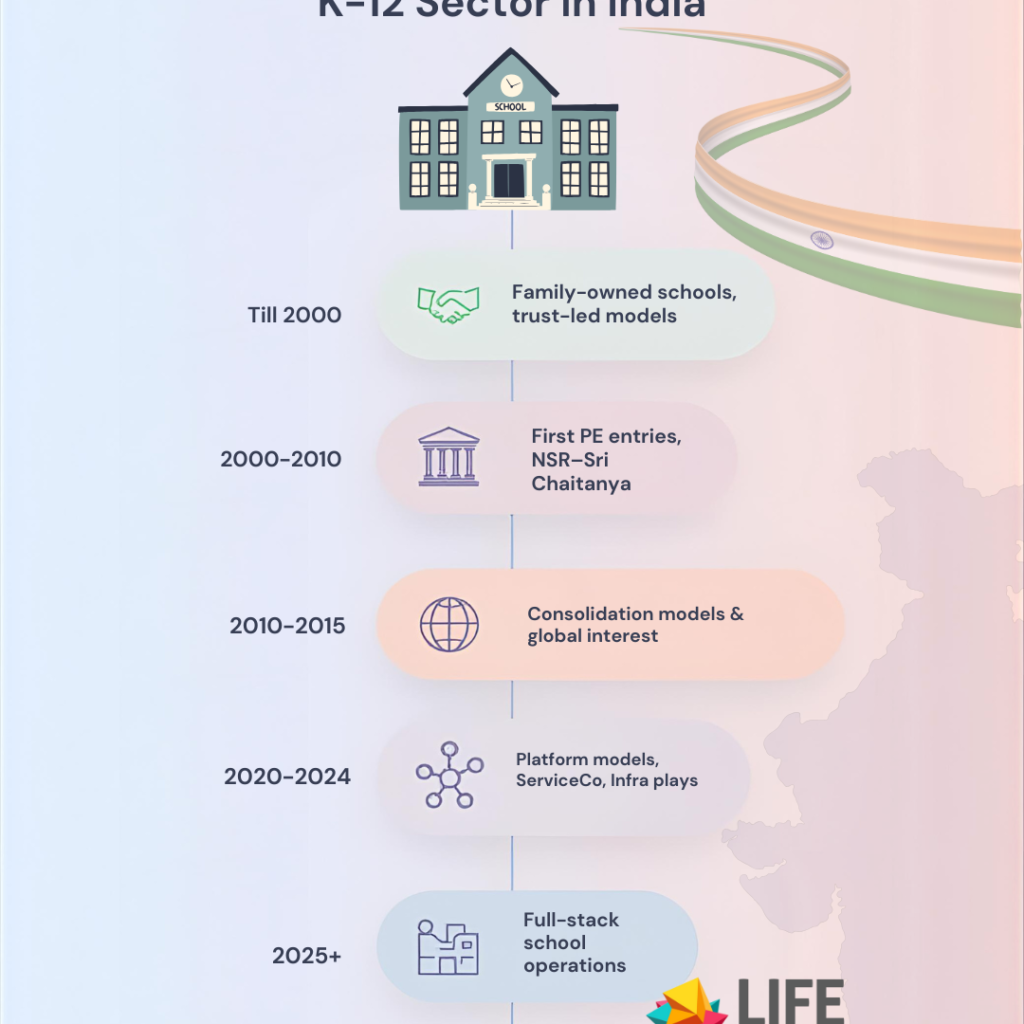
India’s K-12 education landscape is undergoing a historic transformation. Once a sector marked by family-owned institutions and passionate educator-founders, it has become a magnet for billions in private equity and venture capital.
This shift represents a fundamental reshaping of how schools operate, expand, and generate returns for investors—yet it carries profound challenges rooted in India’s unique regulatory framework and social mandate around education.
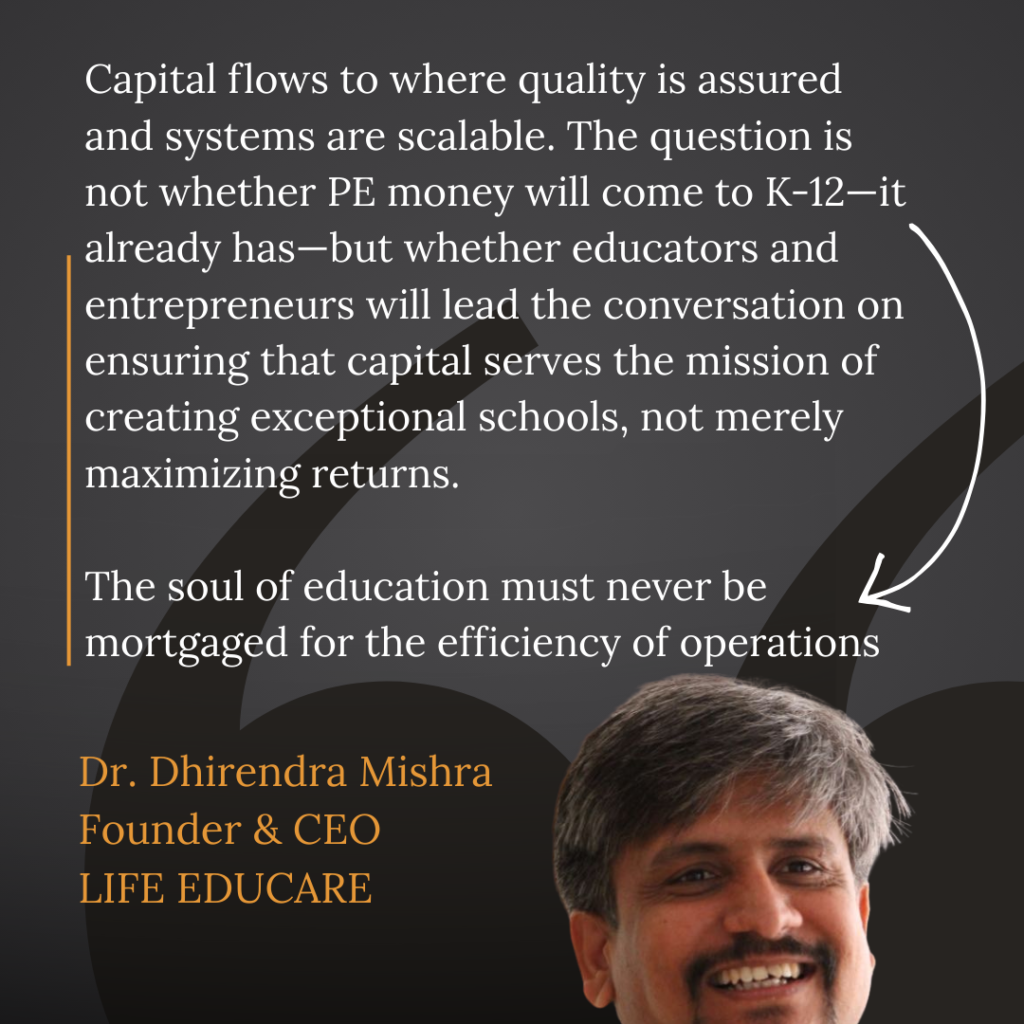
As Dr. Dhirendra Mishra, founder of LIFE Educare and a school startup and education management consultant of 70+ schools across India and gulf reflects on this phenomenon, “Capital flows to where quality is assured and systems are scalable.
The question is not whether PE money will come to K-12—it already has—but whether educators and entrepreneurs will lead the conversation on ensuring that capital serves the mission of creating exceptional schools, not merely maximizing returns.
The soul of education must never be mortgaged for the efficiency of operations.” This report serves as a comprehensive guide for entrepreneurs, investors, and stakeholders navigating this complex but high-potential ecosystem.
Market Fundamentals: Why PE is Betting on Indian K-12
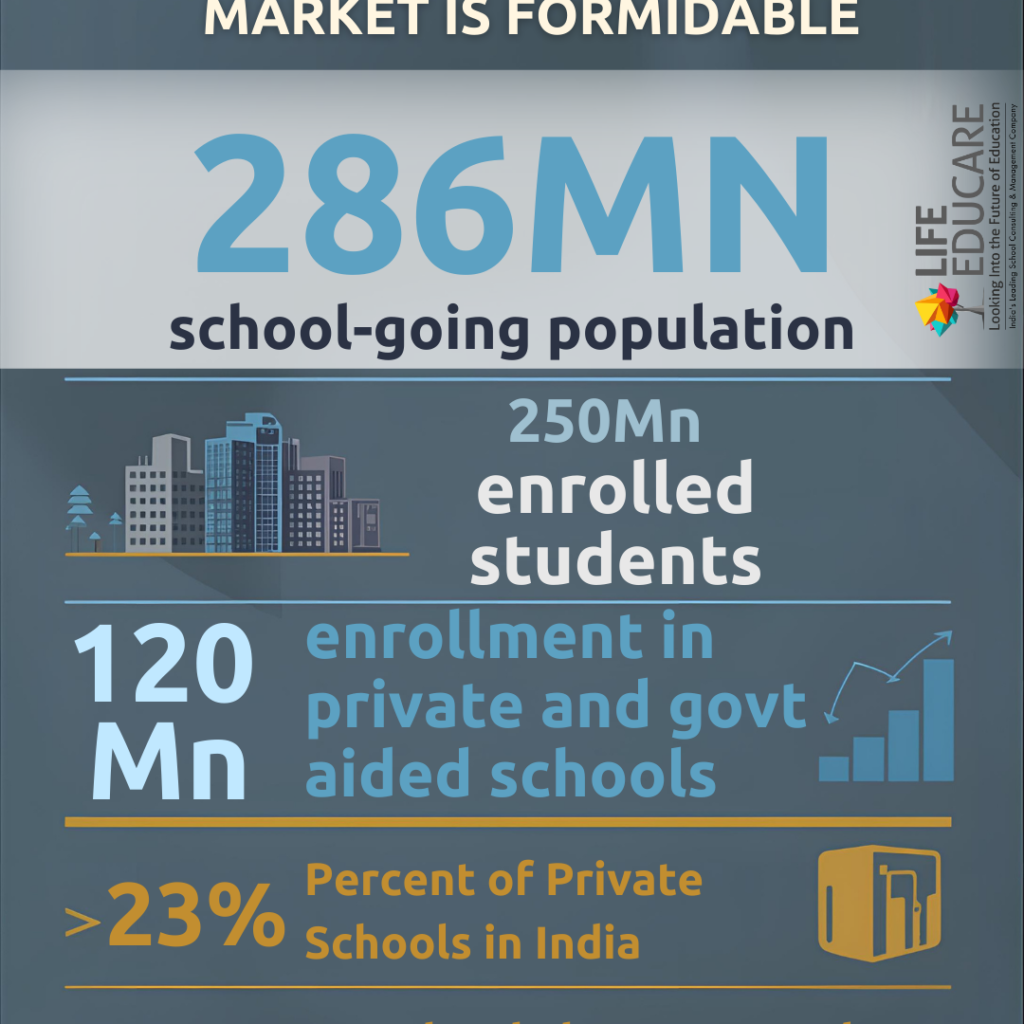
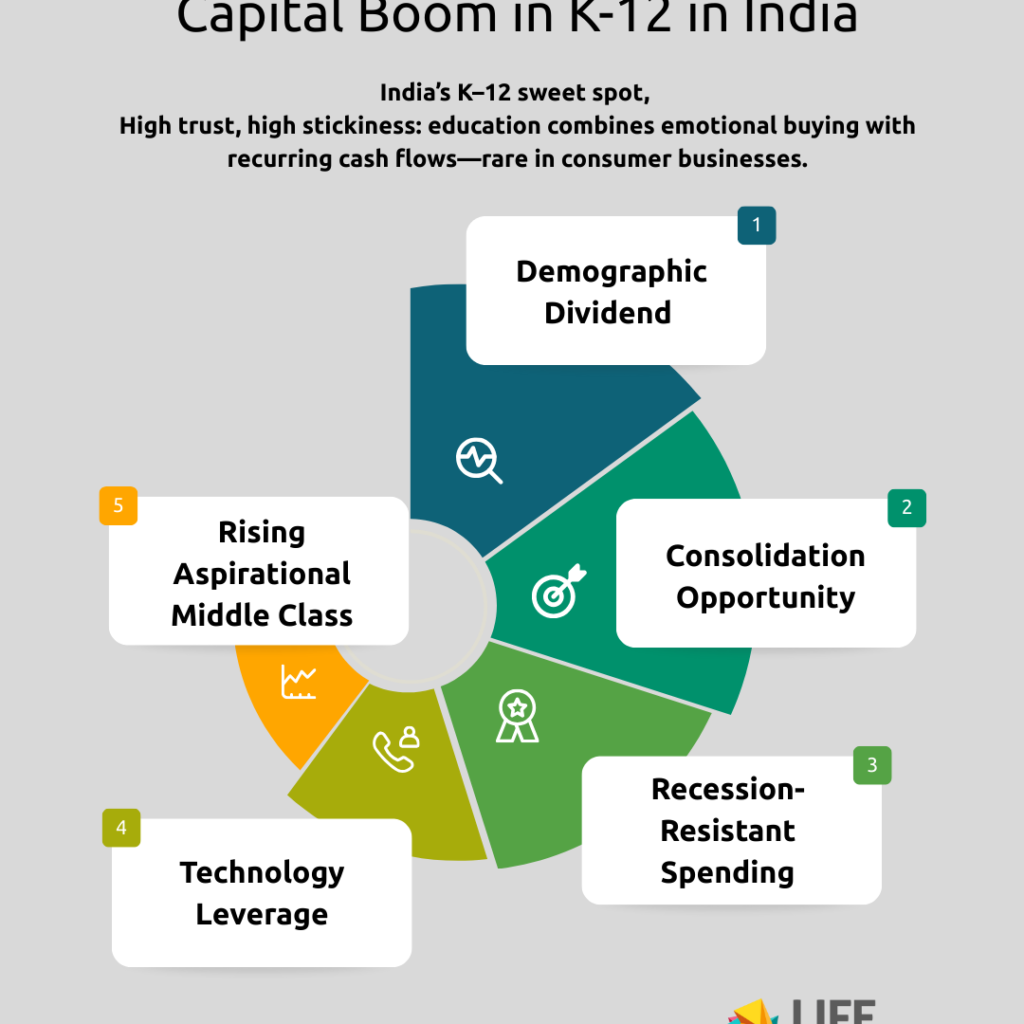
India’s K-12 education market is formidable: 375 million students, 260 million enrolled across 1.5 million schools, and private institutions capturing nearly half of all enrollments in major metros. Private K-12 transactions alone have exceeded $700 million since 2016, with institutional capital only accelerating. The thesis driving this investment is multifaceted.
Demographic Dividend & Rising Aspirational Middle Class
India’s upper-middle class and high-net-worth segments are expanding rapidly. Parents are willing to pay premium tuition for international curricula (IB, IGCSE), English-medium instruction, and holistic development—creating a pricing umbrella that supports sustainable margins.
Consolidation Opportunity:
The K-12 sector remains fragmented. While 1.5 million schools exist, the organized private school market is dominated by smaller regional chains. PE firms see an arbitrage opportunity: consolidate fragmented operators, apply standardized operational templates (curriculum, teacher training, procurement, technology), and unlock significant EBITDA expansion.
Recession-Resistant Spending
Education is largely insulated from cyclical downturns. Fee collection remains predictable, with recurring revenue streams that minimize customer acquisition costs relative to other consumer segments.
Technology Leverage
The integration of EdTech platforms (learning management systems, assessment tools, ERP for school administration) creates operational efficiency and improves unit economics. K-12 Techno Services’ model, for example, leverages a B2B SaaS approach through its Eduvate platform, servicing 800+ schools without owning them—a capital-light expansion that generates recurring revenue.
The PE Giants: Who’s Winning and How
KKR: The Flagship Play
KKR’s November 2019 acquisition of EuroKids (rebranded Lighthouse Learning) for ₹1,475 crore ($174 million) marked a watershed moment, signalling institutional confidence in the sector. Since then, Lighthouse has become the largest consolidated platform:
Network: 1,850+ pre-schools, 60+ K-12 schools, 190,000+ students daily
Brands under KKR
EuroKids, Kangaroo Kids, EuroSchool, Billabong High International, Centre Point, Heritage schools
Financial Trajectory
Revenue grew from ₹688 crore (FY23) to ₹1,000–1,200 crore (FY24), demonstrating the power of consolidation
In November 2025, KKR made a significant follow-on investment alongside Canada Pension Plan Investment Board’s PSP Investments, injecting approximately ₹1,760 crore ($200 million). This move signals KKR’s confidence in the platform’s ability to expand further while deepening its ownership and operational control.
PE Strategy
KKR’s approach emphasizes organic growth (adding 250+ pre-schools annually pre-2021, now 500+ annually) and disciplined M&A (acquiring Centre Point Schools in 2021). The firm is building a billion-dollar education services platform by leveraging shared infrastructure, standardized pedagogy, and technology systems across multiple brands—a “hub-and-spoke” model that competitors are now replicating.
Kedaara Capital: The Aggregator Play
Kedaara Capital’s investment in K-12 Techno Services represents the purest aggregator thesis in Indian K-12. K-12 Techno operates two distinct business models:
1. Orchids International Schools: Directly operated K-12 schools
2. Eduvate: B2B SaaS platform providing curriculum, content, and ERP to 800+ schools
– Funding: $40 million from Kenro Capital (December 2024)
– Valuation: Sequentially rising from $420M (Sept 2023) to $540M (May 2024)
Kedaara is now in advanced discussions to raise $150–200 million at a $800–900 million valuation, with Vitruvian Partners (Europe), ChrysCapital, Warburg Pincus, and Permira reportedly competing. This validates the asset-light, high-leverage operational model where K-12’s capital expenditure is capped at security deposits and infrastructure investments rather than land acquisition.
Blackstone: Platform Building with Pace
Blackstone’s recent move signals a shift toward aggressive platform consolidation. The firm is in advanced talks to acquire a majority stake in Jayshree Periwal International School (JPIS) for $150–200 million, with plans to invest $600–700 million in building a consolidated education platform over the next few years.
Deal Structure: JPIS reported ₹135.2 crore operating revenue in FY25 with net profit doubling to ₹22.5 crore. Post-acquisition, existing management (founder Jayshree Periwal and CEO Ayush Periwal) will remain in place while Blackstone scales the platform across India. This mirrors Blackstone’s successful healthcare consolidation (CARE Hospitals, KIMS Health, $1 billion combined) and signals confidence in the K-12 infrastructure thesis.
Nord Anglia Education: International Entry
In February 2019, Canada Pension Plan Investment Board (CPPIB) and Baring Private Equity Asia–owned Nord Anglia Education acquired Oakridge International Schools for approximately ₹1,500–1,600 crore ($200 million). This cross-border transaction demonstrated appetite from global PE for Indian school assets and marked the first major entry of an international school brand into India through PE backing.
Cerestra Advisors: The Infrastructure Play
Cerestra pioneered the education infrastructure investment trust (Edu-Infra Fund) model. Rather than operating schools directly, Cerestra acquires the real estate assets of school chains and monetizes through infrastructure REITs. This sidesteps the legal non-profit restriction on schools themselves, enabling PE to realize returns through infrastructure appreciation and lease economics.
Cerestra later partnered with AnaCap Financial Partners to create a dedicated education infrastructure vehicle, acquiring Jain Group of Institutions’ K-12 and student housing assets—a blueprint now being adopted by other PE firms seeking to decouple real estate returns from operational compliance challenges.
PE-Backed School Chains: Detailed Snapshot
Sri Chaitanya Schools: The Troubled Consolidation
Sri Chaitanya represents both the opportunity and complexity of PE-backed K-12. Founded in 1986 by Dr. Bopanna Satyanarayana, the chain operates 750+ schools across 23 states with student fee collections exceeding ₹3,500 crore annually.
PE History
– 2010: New Silk Route invested $70 million for 33–49% stake—the largest foreign education investment at that time
– 2014: NSR attempted a $1+ billion exit as the investment cycle matured, but faced valuation disagreements with promoters
– 2019: Brookfield Asset Management and Kalpathi Investments expressed interest in a $1+ billion acquisition, but deals fell through
– 2021: NSR exited a 25% stake at ₹1,100 crore valuation (~$4 billion company valuation)
Lessons: While SR’s financial performance remained strong (EBITDA ~₹900 crore), the complexity of managing promoter expectations, regulatory scrutiny around non-profit mandates, and the difficulty of achieving exit valuations at desired multiples slowed consolidation. Sri Chaitanya’s inability to pursue an IPO (attempted twice with different partners) reflects the regulatory headwinds in India’s K-12 sector.
Narayana Schools: The Founder Buyback
Narayana Group, operating 750+ schools, represents a different exit narrative. Morgan Stanley and BanyanTree Capital invested $75 million in 2018, targeting a 5–7 year horizon. By 2023, the promoters (Ponguru Narayana’s family) decided to take full control, raising ₹1,150 crore via non-convertible debentures anchored by Barclays to provide a $160 million exit to the PE investors. The deal demonstrates how PE exits aren’t always trades to other investors; they can be founder recapitalization where promoters leverage the enhanced valuation and operational improvements driven by PE investment to regain control.
Gautam Adani & Sunny Varkey (GEMS Partnership)
In 2025, the Adani Foundation announced a ₹2,000 crore commitment to establish 20 schools over three years in partnership with GEMS Education, the Dubai-based K-12 giant. This 50-50 JV represents convergence of global capital, ESG commitment (30% seats free for underprivileged students), and asset-light consulting—GEMS will provide curriculum and training while Adani manages operations. This model addresses one of PE’s key pain points: how to scale without triggering non-profit restrictions.
Indus World Schools: The Failure Case Study
Career Launcher’s Indus World Schools (2005–2012) remains the cautionary tale for K-12 PE ventures in India. Founder Satya Narayanan ventured into K-12 schooling while operating a successful test-prep company. Despite HDFC’s ₹50 crore investment, the capital intensity, regulatory burden, and operational complexity of running physical schools contrasted sharply with the asset-light test-prep model. Indus World School of Business, the higher education arm, lost affiliation to Pondicherry University and suspended operations. The experience taught Narayanan a critical lesson: PE-backed education expansion works best when staying within a proven playbook. Career Launcher exited K-12 by 2011–12 to refocus on its core test-prep business, which later went public.
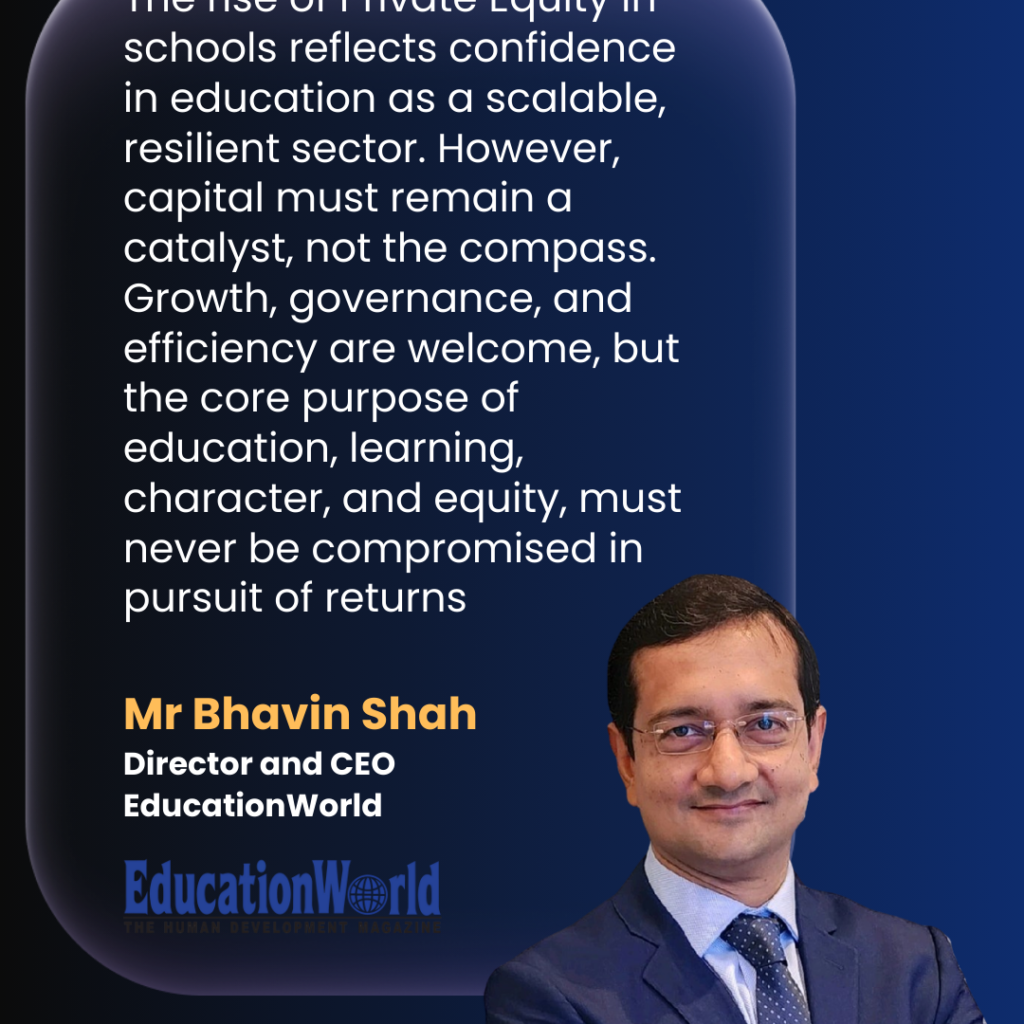
Mr Bhavin Shah, Director and CEO at EducationWorld, India’s largest read magazine addressing the education sector in India is a keen observer of the sector, he remarks that the rise of Private Equity in schools reflects confidence in education as a scalable, resilient sector. However, capital must remain a catalyst, not the compass. Growth, governance, and efficiency are welcome, but the core purpose of education, learning, character, and equity, must never be compromised in pursuit of returns.
Role of Impact Funds
While traditional PE seeks 25%+ IRRs, impact funds accept lower returns in exchange for social outcomes. Several are active in K-12:
Acumen: Invests in affordable private schools and assessment solutions, with focus on learning outcomes and financial sustainability. Reports indicate Acumen’s K-12 sector strategy emphasizes schools serving lower-middle-income families.
Omidyar Network: Supports innovative school models, teacher training, and education finance. Their portfolio includes Indian School Finance Co., demonstrating a blended approach to access and quality.
Varthana: Pioneered education-focused non-bank lending, financing school infrastructure and teacher training. ChrysCapital led a $50 million series in 2018, validating the model of financing without ownership.
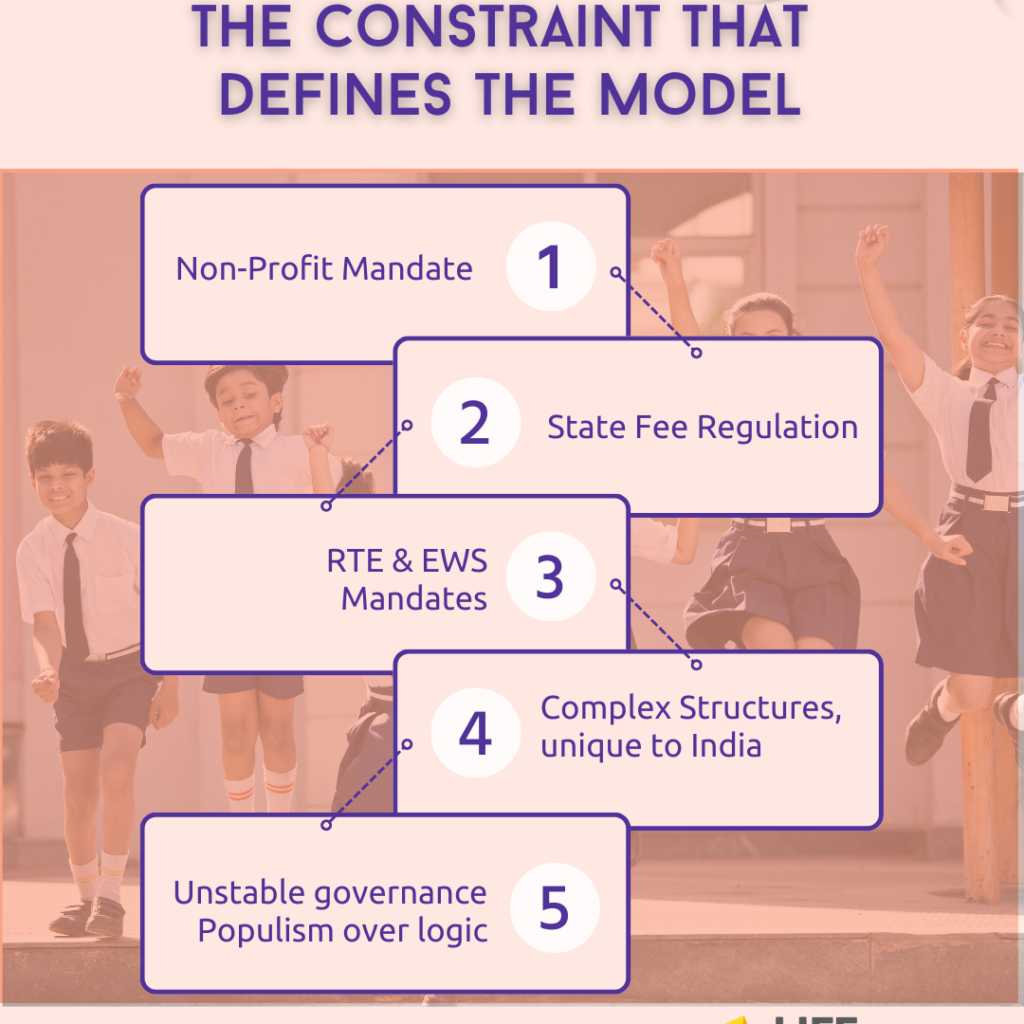
Challenges: The Constraint That Defines the Model
India’s constitutional and legal framework restricts K-12 schools from operating for profit. This architectural challenge shapes every PE investment thesis:
Key Constraints:
Non-Profit Mandate (RTE Act 2009, Model Rules): Schools seeking recognition must declare they are “not run for profit to any individual, group or association.” Supreme Court verdicts (Unnikrishnan 1993, TMA Pai 2002) establish education as a “charity” and disallow profiteering, though “reasonable surplus” for expansion is permitted.
Fee Regulation: No uniform national policy exists. States (Delhi, Karnataka, Maharashtra, Tamil Nadu, Gujarat, Rajasthan) impose fee caps ranging from 8–15% annual increases. Gujarat’s hard-cap model caps primary fees at ₹15,000 and secondary at ₹25,000, though exemptions for “Schools of Excellence” are contested.
Right to Education / EWS Reservation: August 2024 Supreme Court ruling requires all private schools to reserve 25% seats for economically weaker students, reducing effective pricing power.
Direct Restrictions: PE firms cannot directly own schools; they must operate through non-profit trusts or educational societies, necessitating complex structures where trusts own schools and PE firms provide services or own real estate.
Unstable governance – Populism over logic: Education’s status as a state subject creates fragmented governance and policy unpredictability, often amplified by populist decisions that override academic and economic logic. This regulatory volatility raises risk premiums, disrupts long-term planning, and deters serious institutional investment in high-quality, scalable K–12 schools.
How PE Navigates These Restrictions
Service Company Model
K-12 Techno, Lighthouse, and Orchids operate through for-profit service entities that provide management, curriculum, technology, and staffing to schools registered as non-profits. PE owns the service company, not the school.
Infrastructure Play
Cerestra and AnaCap acquire the real estate underlying schools, monetizing through REIT structures that generate returns independent of school profitability restrictions.
Board Diversification
Lighthouse’s board includes education leaders (Indu Shahani) and business figures (Bijou Kurien, Ashish Kashyap) to ensure credibility and operational excellence beyond financial returns.
Why Multiples are Expanding
EdTech valuations have compressed to but offline K-12 schools with recurring tuition revenue and high operating leverage command premium multiples due to predictability and capital efficiency. The shift from high-growth, low-margin EdTech to profitable, scalable school operations explains PE appetite.
How to build an Investment Deck for K-12 Entrepreneurs
The PE Investment Lens in K-12
Every institutional investor evaluates K-12 through three simultaneous lenses
Lens 1: Education Outcomes (License to Operate)
Learning outcomes
Teacher quality & stability
Parent trust / brand credibility
Regulatory goodwill
Lens 2: Unit Economics (License to Scale)
Contribution margin per student
Teacher cost as % of revenue (ideal: <45%)
Infrastructure ROI per seat
Working capital advantage (advance fees)
Lens 3: Structuring Arbitrage (License to Monetize)
ServiceCo vs Trust separation
Infra monetization potential
Exit optionality (secondary sale, REIT, founder recap)
Steps to follow
Market Opportunity & Positioning
Define addressable market (e.g., “4 million students in metros seeking international curricula” = ₹20,000 crore market at average ₹5 lakh tuition)
Team Depth: Highlight functional leaders in curriculum, operations, finance, and technology
Exit Visibility
IPO Pathway: Reference CL Educate’s IPO, though acknowledge regulatory constraints and longer timelines vs. B2C tech
Strategic Buyer Interest: Evidence of inbound interest from global chains (e.g., Nord Anglia, GEMS)
Secondary Sale Potential: Show how PE can achieve 5–7 year exits to newer investors (Kenro Capital’s K-12 Techno deal, Venturi’s stake purchase)
Challenges & Risks
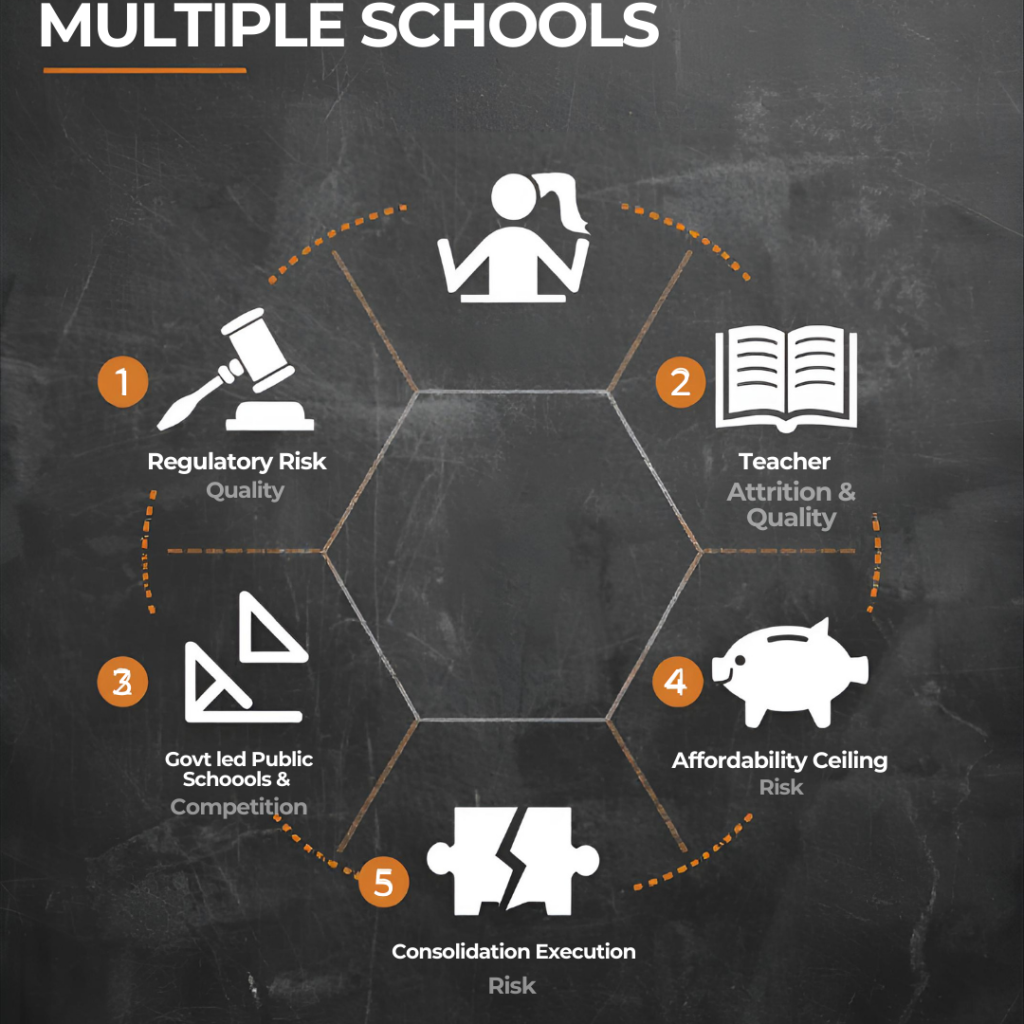
Regulatory Risk
The RTE Act and fee regulation remain contentious. A hypothetical crackdown on “excessive” growth or compliance violations could impact valuation. Investors must assess state-level regulatory volatility—Tamil Nadu, Delhi, and Rajasthan are more active in enforcement than others.
Teacher Attrition & Quality
K-12 success depends on teacher quality, but India faces chronic shortages of trained educators. PE firms must invest in teacher training and retention, cutting into margins. Lighthouse’s emphasis on pedagogy training is a competitive response to this risk.
Public School Competition
Government spending on PM SHRI (Pradhan Mantri Schools for Rising India) and NEP 2020 implementation could strengthen public schools, dampening private school growth. Early investors in under-resourced geographies face execution risk.
Affordability Ceiling
Fee caps in almost all the states now, where a school is not allowed to increase beyond a certain single digit percentage every year. PE exits may be pressured if regulation tightens across major metros, eroding the high-margin expansion thesis.
Consolidation Execution Risk
Acquiring regional chains and integrating them into a standardized platform requires operational discipline. Cultural fit, technology migration, and teacher retention during integration are execution challenges that separate winners (Lighthouse) from strugglers.
Emerging Trends & Opportunities
Asset-Light Models Winning
K-12 Techno’s Eduvate platform, serving 800+ schools without owning them, is the fastest-growing segment. PE is rotating capital toward B2B SaaS models that avoid ownership headaches while scaling impact.
Infrastructure REITs as Exit Vehicles
Cerestra and AnaCap are pioneering education infrastructure investment trusts, allowing PE to monetize real estate separately from school operations. This may become a primary exit route given non-profit restrictions on schools themselves.
Global Capital Inflows
CPPIB (Oakridge), GEMS-Adani partnership, and KKR’s follow-on show sustained global capital interest. INR appreciation and India’s long-term growth narrative continue attracting sovereign wealth and pension funds.
The Inflection Point
India’s K-12 education sector stands at an inflection point. Consolidated platforms with recurring revenue, predictable unit economics, and clear operational templates are attracting institutional capital at scale. Entrepreneurs with differentiated brands, proven scalability, and regulatory clarity can access $50–200 million in PE funding within 3–5 years of demonstrating traction.
The non-profit constraint, far from being a fatal flaw, has forced PE to innovate—creating service company models, infrastructure plays, and B2B platforms that are often more sustainable than traditional ownership. Investors should focus on management quality, regulatory positioning, and path to profitability rather than hyper-growth narratives that dominated EdTech.
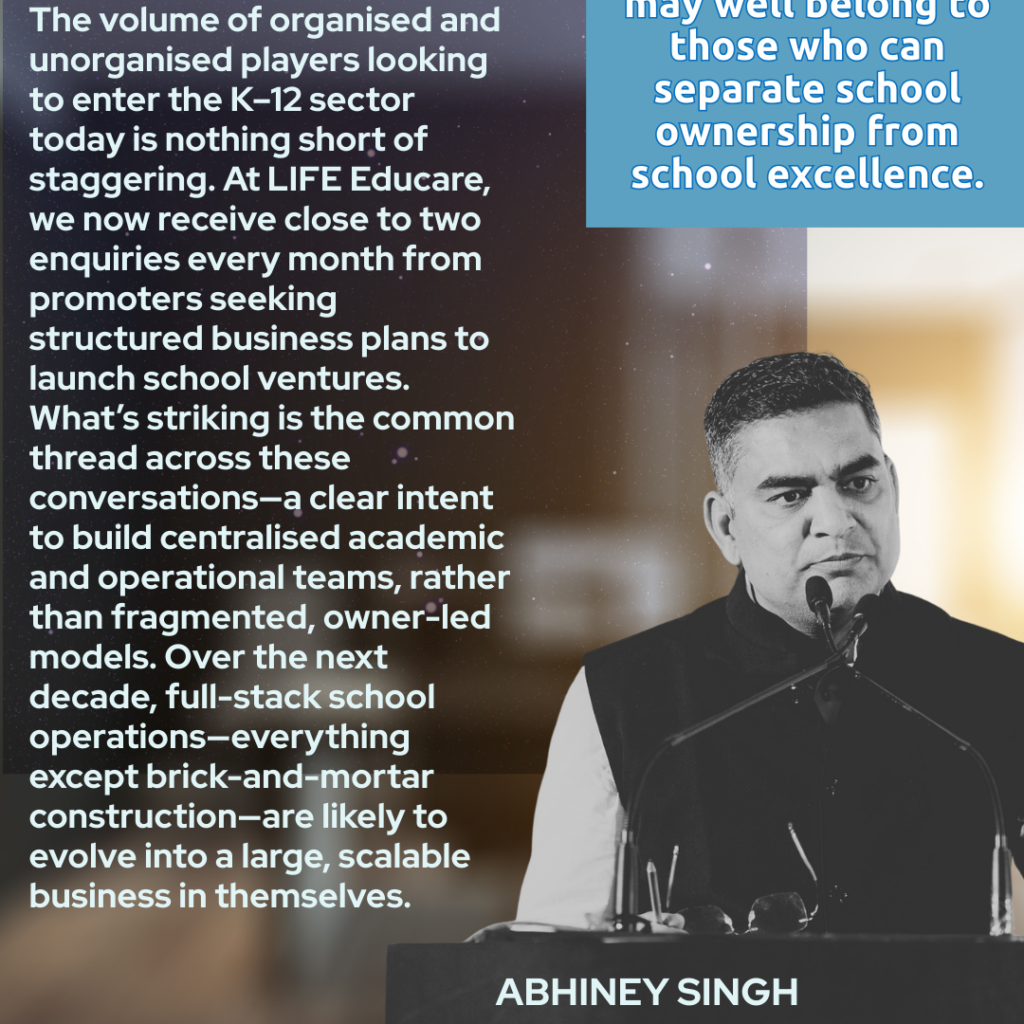
Abhiney Singh, Partner at LIFE Educare and promoter of a CBSE school with 3,000+ students, notes that the volume of organised and unorganised players looking to enter the K–12 sector today is nothing short of staggering. At LIFE Educare, we now receive close to two enquiries every month from promoters seeking structured business plans to launch school ventures. What’s striking is the common thread across these conversations—a clear intent to build centralised academic and operational teams, rather than fragmented, owner-led models. Over the next decade, full-stack school operations—everything except brick-and-mortar construction—are likely to evolve into a large, scalable business in themselves. The future of K–12 may well belong to those who can separate school ownership from school excellence.
For aspiring entrepreneurs, the playbook is clear: build a strong unit economics foundation, demonstrate geographic replicability, and prepare for disciplined M&A execution. PE backing is no longer a luxury; it’s an essential ingredient for scaling K-12 platforms in India’s fragmented but dynamic market.
A strong teacher recruitment strategy for schools is the foundation of quality education. Hiring the right teachers is not just about filling classrooms—it is about shaping young minds, nurturing character, and ensuring long-term academic and personal success for students.
An effective recruitment strategy helps schools attract educators who are passionate, skilled, and aligned with the institution’s educational vision. When schools invest in the right faculty, they invest directly in their reputation, student outcomes, and sustainable growth.
Why Teacher Recruitment Strategy for Schools Is Important
A well-planned teacher recruitment strategy for schools ensures that educators possess both academic expertise and essential human qualities such as empathy, creativity, and communication skills.
Schools that focus on hiring teachers who support:
ersonality development
confidence building
communication and grooming
create students who excel academically and socially. This approach prepares learners not just for exams, but for real-life challenges.
Key Qualities to Focus on While Hiring Teachers
An effective teacher recruitment strategy for schools goes beyond qualifications and experience. Schools should look for teachers who demonstrate:
Adaptability to different learning styles and child psychology
Strong classroom management with a calm and supportive approach
Commitment to student grooming, discipline, and confidence
Ability to encourage teamwork, empathy, and communication
Integration of moral values and positive behavior in daily teaching
Willingness to continuously upgrade teaching and digital skills
Teachers with these qualities contribute to holistic student development and long-term school success.
Step-by-Step Teacher Recruitment Strategy for Schools
Define Clear Teaching Roles and Expectations
A clear recruitment strategy begins with well-defined roles. Schools should communicate expectations related to:
modern teaching methodologies
co-curricular involvement
mentoring students for confidence and personality development
This attracts educators aligned with the school’s values.
Highlight School Culture and Educational Values
An effective teacher recruitment strategy for schools showcases a culture of:
discipline and etiquette
open communication
innovation and skill development
Promoting workshops, training programs, and character-building initiatives helps attract quality educators.
Use Multiple Recruitment Platforms
To strengthen your teacher recruitment strategy for schools, use:
Online job portals like Naukri, Indeed, LinkedIn
Professional teaching networks
Alumni referrals and teacher training institutes
This widens the talent pool and improves hiring quality.
Evaluate Communication and Personality Skills
Recruitment should assess more than academic ability. Schools must evaluate:
communication clarity
student engagement techniques
experience in confidence-building or value-based programs
These factors ensure teachers positively influence student behavior and mindset.
Conduct Structured Multi-Round Interviews
A successful teacher recruitment strategy for schools includes:
Subject knowledge assessment
Demo classes focused on values or engagement
Final interaction to judge attitude and student connection
Sample interview questions:
“How do you help shy students build confidence?”
“How do you address behavioral challenges in class?”
Train and Support Newly Recruited Teachers
Recruitment does not end at hiring. Schools should:
provide onboarding in communication and body language
train teachers in moral education and emotional handling
offer continuous mentoring support
This strengthens long-term teaching effectiveness.
Retain and Motivate Quality Teachers
An effective teacher recruitment strategy for schools also focuses on retention by offering:
regular professional development
recognition for student development efforts
leadership and growth opportunities
Motivated teachers stay longer and perform better.
Role of School Leadership in Teacher Recruitment Strategy
School leaders play a vital role in executing a successful teacher recruitment strategy for schools. Principals and academic heads should:
hire teachers aligned with the school’s vision
promote collaboration and mentoring
model discipline, empathy, and communication
Strong leadership ensures consistency and quality in teaching standards.
Teacher recruitment is one of the most critical pillars while setting up a CBSE school. Along with hiring the right faculty, schools must also meet infrastructure, academic, and administrative standards to ensure long-term success.
Getting affiliation for your school in India is a major milestone for any education entrepreneur or institution. A CBSE-affiliated school not only gains national recognition but also follows a standardized, future-ready curriculum designed for holistic student development.
However, the CBSE affiliation process can seem complex due to documentation, infrastructure norms, inspections, and compliance requirements.
This detailed guide explains how to get affiliation step by step, the documents required, updated affiliation fees, and how Life Educare can support you from planning to final approval.
What Is CBSE Affiliation?
The Central Board of Secondary Education (CBSE) is one of India’s most respected national education boards. affiliation allows schools to implement a uniform curriculum, assessment structure, and academic framework aligned with national education standards.
To obtain affiliation, schools must strictly follow guidelines related to:
Land and infrastructure
Safety and statutory approvals
Qualified teaching staff
Academic planning and governance
Types of CBSE Affiliation
CBSE offers different affiliation categories depending on the stage of your school:
Provisional Affiliation
Granted to newly established schools meeting CBSE norms.
Regular Affiliation
For schools already operating under CBSE guidelines.
Extension of Affiliation
Renewal of affiliation after the validity period.
Upgradation of Affiliation
For schools upgrading from Secondary (Class 10) to Senior Secondary (Class 12).
Step-by-Step Process to Get CBSE Affiliation
Step 1: Establish School Infrastructure
Meeting infrastructure and legal norms is critical. Read our detailed article on CBSE school setup requirements to understand the complete process.
Ensure your school meets CBSE norms related to:
Minimum land area
Safe school building
Fire, health, and structural safety
Laboratories, library, and playground
Qualified teaching and administrative staff
Step 2: Register and Apply Online
Apply through the official CBSE SARAS portal:
Create your school login and carefully fill in:
Trust/society details
Infrastructure data
Academic information
Step 3: Upload Required Documents
Upload all mandatory documents in PDF format as per the CBSE checklist.
Step 4: CBSE Inspection & Verification
A CBSE-appointed inspection committee visits your school to verify:
Infrastructure
Safety compliance
Staff credentials
Academic readiness
Step 5: Pay CBSE Affiliation Fees
Pay the applicable fees online through the SARAS portal.
Step 6: Approval & CBSE Affiliation Code
After successful inspection and verification, CBSE issues:
Affiliation approval letter
Unique CBSE affiliation number
Required Documents for CBSE Affiliation
Prepare these documents in advance to avoid delays:
Registered land ownership or lease deed (minimum 15 years)
State/UT recognition certificate
No Objection Certificate (NOC)
Building safety & structural stability certificate
Fire safety certificate
Health and sanitation certificate
Staff appointment letters with qualification proof
Audited balance sheet and audit report
CBSE compliance report
Details of classrooms, laboratories, and library
Updated CBSE Affiliation Fees (2025)
As per CBSE Circular No. 14/2024, the latest fee structure is:
Category
Fees (INR)
Applicable For
Fresh Affiliation (Secondary)
₹50,000
Up to Class 10
Fresh Affiliation (Senior Secondary)
₹75,000
Up to Class 12
Extension of Affiliation
₹25,000
Renewal
Upgradation of Affiliation
₹50,000
Class 10 to 12
Switch Over (Other Boards)
₹75,000
ICSE/State to CBSE
Inspection Fee
₹10,000
One-time (Non-refundable)
Payments must be made only via the CBSE SARAS portal.
For updates, always refer to the official CBSE website.
How Life Educare Helps in Getting CBSE Affiliation
Life Educare is a trusted name in school setup, affiliation, and academic planning across India. Their expert team ensures a smooth, error-free affiliation journey.
Life Educare’s Affiliation Support Includes:
CBSE Readiness Audit Evaluation of infrastructure, documents, and compliance gaps.
Complete Documentation Support Preparation of affiliation forms, checklists, and inspection files.
Infrastructure & Academic Planning Alignment with CBSE norms for buildings, labs, staff, and facilities.
Curriculum Design & Implementation Focused on:
Leadership and critical thinking
Project-based learning
Technology-integrated classrooms
Creativity and teamwork
Career and life skills education
Community-building activities
Why Choose Life Educare?
With years of experience in school setup and affiliation, Life Educare offers more than just paperwork support. They help schools build modern, student-centric learning environments aligned with CBSE’s long-term vision.
Final Thoughts
Getting affiliation for your school in India requires careful planning, accurate documentation, and strict compliance with CBSE guidelines. With expert guidance, the process becomes structured, transparent, and achievable.
Life Educare acts as a complete bridge—helping schools move confidently from planning to approval while ensuring long-term academic excellence.
CBSE School Budget in India is the most important factor to consider when planning to open a new CBSE school. Starting a CBSE school is a rewarding venture in the education sector, combining long-term sustainability with strong social impact.
However, one of the first and most important questions every school promoter asks is about the actual budget required to open a CBSE school in India.
There is no single fixed number. The total CBSE school budget depends on multiple factors such as location, land availability, infrastructure scale, facilities, and the overall educational vision you want to deliver.
Understanding the CBSE School Budget in India Before Planning
Before calculating costs, it is essential to define why you are opening a school. Your purpose directly influences every financial and operational decision.
Ask yourself:
Do you aim to offer affordable quality education or build a premium CBSE institution?
Will the school operate as a day school or a residential (boarding) school?
Which classes will you start with, and how will the school expand over time?
How much importance will be given to extracurricular and co-curricular development?
Clear answers to these questions help align land usage, infrastructure development, and investment planning with CBSE norms, ensuring structured and goal-oriented budgeting.
Land and Infrastructure Requirements for CBSE School Setup
Land planning plays a major role in determining the overall CBSE School Budget in India, especially in urban and semi-urban locations.
Land Area: Approximately 1.5 acres in non-exempted cities (some urban areas may have relaxed norms)
Built-up Area: For a full-fledged Nursery to Class 12 school with four sections per class, around 55,000–60,000 sq. ft is recommended
These requirements may vary based on location and future expansion plans.
Construction Rollout Plan for CBSE Schools
Construction and furnishing together account for the largest share of the CBSE School Budget in India.
Stage 1 – Initial Setup
20,000–25,000 sq. ft
Pre-primary and primary classrooms
Administrative block and basic amenities
Stage 2 – Expansion Phase
18,000–20,000 sq. ft
Middle school classrooms
Science and computer laboratories
Stage 3 – Final Development
12,000–15,000 sq. ft
Senior secondary infrastructure
Activity rooms and specialized facilities
Phased development allows early operations and gradual capital deployment.
Construction and Furnishing Costs in a CBSE School Budget
High-quality furnishings, smart classrooms, and advanced labs increase the CBSE School Budget in India, but they also enhance learning outcomes and brand value.
Construction costs currently range between ₹1,000–₹1,400 per sq. ft, depending on local material prices and labor availability. Accurate regional quotations are essential for realistic budgeting.
A CBSE school with a built-up area of around 50,000 sq. ft typically requires:
₹5–7 crore for construction (classrooms, admin blocks, utilities)
Furnishing costs average ₹350–₹600 per sq. ft, influenced by:
Furniture quality
Classroom interiors
Smart classroom technology
Advanced laboratory setups
Schools focusing on modern learning environments should plan a higher furnishing investment.
Startup and Operational Expenses
Staff recruitment, initial marketing, and legal compliance are crucial components of the CBSE School Budget in India that every promoter must plan for.
Branding and promotions: ₹20–25 lakh
Staff recruitment and training: ₹25–30 lakh annually
Licensing, affiliation, and legal processes: ₹10–15 lakh
Operational reserve: Around ₹1 crore for first-year stability
These expenses ensure smooth launch and uninterrupted academic operation
CBSE School Budget Breakdown Based on School Type
Type of School
Construction Area
Estimated Budget
Key Features
Low-Budget CBSE School
25,000–30,000 sq. ft
₹3–4 crore
Basic infrastructure, limited sections
Standard CBSE School
40,000–55,000 sq. ft
₹6–15 crore
Full academics, labs, library, activities
Premium Residential School
70,000+ sq. ft
₹15 crore & above
Boarding, sports, smart classrooms
Note: Land cost is additional and varies significantly by location.
How Land Ownership Impacts the CBSE School Budget
Owning land upfront can reduce the total CBSE School Budget in India by 30–40%, making it a smart move for first-time promoters.
₹50 lakh per acre in rural areas
₹10 crore or more in prime urban locations
For first-time promoters, long-term leasing or pre-owned land often proves to be a smarter financial choice.
Phased Cost Planning for Better Financial Control
Phased execution is one of the most effective ways to optimize the CBSE School Budget in India without compromising quality.
Phase 1 – Foundation Phase
Pre-primary to Grade 5
Core classrooms and admin block
Phase 2 – Expansion Phase
Grades 6–10
Labs, library, staff facilities
Phase 3 – Senior Secondary Phase
Grades 11–12
Stream-specific labs and clubs
This strategy helps schools achieve operational stability within 3–4 years.
Breakeven Analysis for CBSE School Projects
Every CBSE school faces two key breakeven milestones:
Operational Breakeven: Achieved when annual revenue covers salaries, utilities, and maintenance (typically within 3–4 years)
Capital Breakeven: Recovery of total investment, usually within 8–10 years, depending on fees and enrollment strength
A strong marketing and admissions strategy can significantly shorten these timelines.
Factors That Influence the Final CBSE School Budget
Several variables impact cost differences between schools:
Location and city category
Day school vs residential model
Sports, auditoriums, and activity facilities
Quality of construction and technology
Compliance, affiliation timing, and board selection
Understanding these factors helps promoters avoid unexpected financial stress.
Making the Right Start — Plan, Phase, and Execute
With careful planning, every promoter can optimize the CBSE School Budget in India to build a financially viable and successful CBSE school.
Opening a CBSE school is both a dream project and a long-term social investment. For aspiring promoters, the key lies in clear vision, phased execution, and practical budgeting.
A promoter aiming for a modest, sustainable school can begin with ₹3–4 crore excluding land, while one envisioning a large-scale institution should plan for ₹10–15 crore or more.
By aligning the school’s design with your educational motto—whether affordability, excellence, or innovation—you can build an institution that not only becomes financially viable but also leaves a lasting educational legacy
Get Expert Support for CBSE School Setup & Budget Planning
CBSE School Setup requires careful planning, compliance with regulations, and proper infrastructure to launch a successful institution.
If you are planning to open a CBSE school franchise? Understanding the requirements for new CBSE school setup is essential for launching a successful institution, ensuring compliance, and securing official affiliation.
Below you’ll find answers to all the key questions every school entrepreneur, investor, or trust must know before starting out.
Frequently Asked Questions About Requirements for New CBSE School Setup
Q1. What is the first legal requirement for a school setup?
To fulfill the requirements for new school setup, you must first form a non-profit organization— either a Society, Trust, or Section 8 Company. Registering this entity is mandatory for CBSE affiliation and lays the legal foundation for your school.
Q2. How much land is required for a new CBSE school?
As per CBSE norms, the requirements for new school setup include a minimum of 1.5 acres of non-agricultural land. Some metro and special category cities offer exemptions, but the land must be converted officially to educational use.
Q3. What are the infrastructure requirements for new school setup?
Key requirements for new school setup include:
Classrooms (minimum 6m x 8m each)
Science labs (at least 6m x 9m)
Library (minimum 1200 sq. ft.)
Playground and recreation zones
Washrooms, drinking water, and fire safety systems
Q4. What permissions and approvals must be obtained before construction?
You must obtain approved building plans from local authorities and strict compliance with CBSE infrastructure guidelines is a critical requirement for new school setup. Expert educational consultancy helps ensure all local norms are met.
Q5. How does staff recruitment fit into the requirements for new CBSE school setup?
Recruiting qualified teachers, administrative staff, and support personnel is among the main requirements for new CBSE school setup. Hire based on CBSE staff-student ratio norms and plan recruitment in stages as your school expands
Q6. What is the importance of marketing in CBSE school setup?
Marketing is vital among the requirements for new CBSE school setup for attracting admissions in your launch year. Prepare digital and local campaigns, organize events, and highlight your school’s unique selling points.
Q7. What is the affiliation process with the State Board and CBSE?
After meeting the infrastructure requirements for new CBSE school setup, gain recognition from your state board, then obtain a No Objection Certificate (NOC) before applying online for CBSE affiliation.
Q8. How does the CBSE inspection and approval process work?
CBSE will send an inspection team to check how well you’ve met all requirements for new CBSE school setup—including infrastructure, staffing, and compliance. Prompt response to feedback ensures quick approval.
Q9. What typical investment is needed to meet the requirements for new CBSE school setup?
The usual investment ranges from ₹2 crore to ₹5 crore, depending on facilities and scale. Life Educare can guide you with solutions tailored to maximize ROI and fulfill all requirements for new CBSE school setup.
Q10. How can Life Educare help satisfy the requirements for new CBSE school setup?
Life Educare specializes in turnkey school setup, property exchange, staff recruitment, planning, compliance documentation, and marketing strategy—covering all requirements for new CBSE school setup for seamless school launch.
Contact Life Educare Today to Meet All Requirements for New CBSE School Setup
Buy & Sell School
Phone: +91 81098 04141
Email: info@lifeeducare.com
School Setup & Management
Phone: +91 97136 23000
Email: info@lifeeducare.com
HR
Phone: +91 62628 88899
Email: priya@lifeeducare.com
lifeeducare.com and get expert support for every stage in the requirements for new CBSE school setup!